In manufacturing, speed is essential. So is having a workforce with the skills to keep pace. Getting workers up to speed requires upskilling, but paradoxically, increased training efforts can interrupt the agility and efficiency needed to keep manufacturers competitive.
That’s the push and pull of modern-day manufacturing, the proverbial catch-22: If you pause production to train, you lose time and money. If you skip training, the skills gap widens until it swallows your competitive edge.
The only way forward? Making learning part of the work itself.
Growing, but not slowing
The impact of traditional training on production can be staggering. It can strain teams, reshuffle shifts, create backlogs, drive up overtime, and delay customer orders. And when unplanned downtime costs can exceed $25,000 an hour—in some cases 20 times that—every pause comes with a price tag. But in order to remain competitive, upskilling is no longer optional.
In manufacturing, there’s no arguing with the urgency: the sector may need to add 3.8 million new jobs by 2033. And nearly two million of those jobs are at risk of going unfilled if workforce challenges like skills gaps and labor shortages aren’t addressed. Upskilling is how workers stay current, master new machinery, and evolve their roles to meet changing needs. A recent study found that strategically-planned training enhances both innovation and organizational alignment.
Upskilling also drives retention. Nearly 70% of employees say upskilling improves their job performance, while two-thirds credit it with supporting their professional growth. Employees aren’t just willing to learn—they expect opportunities that keep them relevant and invested in their careers, without forcing a choice between growth and productivity.
Closing the gap between learning and doing
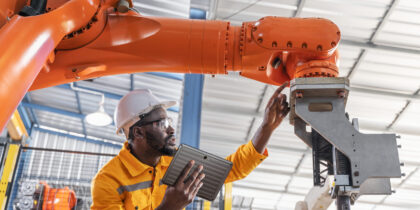
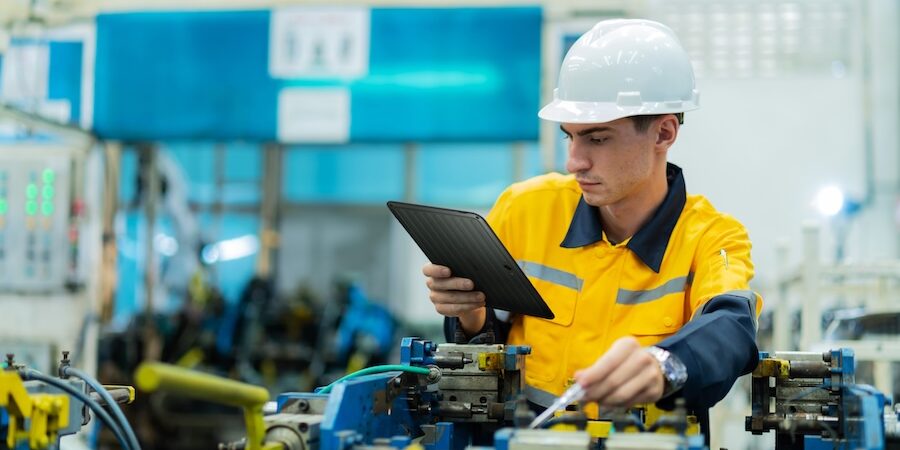
Increasingly, manufacturers are seeking out training programs that don’t interrupt operations. This training is truly “on the job” and embedded into the workday itself. Short, targeted lessons during natural lulls like shift changes or equipment resets can help preserve workflow. Real-time instruction from line leads can also reinforce new procedures where they’re most needed. Even visual and digital prompts can help reduce lapses in memory when they matter most.
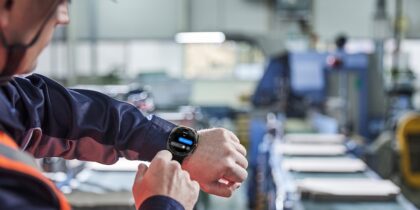
To get the most out of these micro trainings, robust, low-latency connectivity is crucial. Samsung’s devices supporting Band N48 offer dedicated spectrum for both 4G LTE and 5G services. This capability delivers higher capacity and lower latency. It also enables the creation of highly reliable and secure private 5G networks, ensuring critical operations remain uninterrupted while eliminating downtime due to network outages.
Cutting edge technologies also amplify these moments. Extended Reality (XR) training, which uses virtual and augmented reality to provide immersive digital overlays, is emerging as a powerful tool for manufacturers. It allows for safe, hands-on interaction with dangerous equipment in virtual environments, facilitates immersive on-site training, and can significantly reduce travel expenses.Samsung plays a pivotal role in powering these solutions, providing high-performance hardware for immersive XR experiences as well as tailored deployment strategies for both advanced connectivity and XR applications.
The demand for integrated, tech-driven training methods is underscored by evolving global trends. According to the World Economic Forum, by 2025, over 85 million jobs may be displaceddue to automation. At the same time, 97 million new roles could emerge—roles better suited for those operating at the intersection of humans, machines, and algorithms.
By breaking training into micro-units and leveraging sophisticated tools and connectivity, manufacturers can ensure workers are stepping into these new opportunities without pausing production.
Putting skills into action
It’s becoming clear that training programs are most effective when they are woven into the fabric of work. Siemens’ SINUMERIK e-Learning, for instance, brings CNC training directly to the shop floor, allowing operators to build skills without leaving their stations. Caterpillar’s operator training also delivers on-the-job instruction during real equipment use, helping teams strengthen safety and performance while keeping production in motion.
Keys to making training part of the production process:
- Pinpoint high-impact skills: Prioritize in-flow training for operator capabilities that directly impact safety, productivity, and machine uptime.
- Find natural pauses: Siemens’ e-learning shows how modular training can slot into small units of downtime such as scheduled maintenance.
- Use micro-sessions: Replace full-shift halts with short lessons that build skills over time. Siemens positions this as “learning in small units” designed to minimize disruption.
- Train where the work happens: Cat emphasizes in-cab, on-the-job coaching, allowing operators to practice on live equipment while guided by an expert.
- Reinforce in real time: Both models prioritize immediate application, whether through Siemens’ practice modules at the machine interface or Cat’s real-time operator feedback in the field.
- Keep communication flowing: Cat training underscores the role of clear, consistent coaching and communication, ensuring updates or changes don’t require pulling workers off their stations.
When done right, real-time learning can break the manufacturing catch-22 and close the skills gap—all without hitting the brakes on production.
Want to skill up without slowing down? Discover how Samsung solutions can help.