Think companies are backing away from sustainability investments? Think again.
Despite mounting political pushback against ESG (Environmental, Social and Governance) programs most companies are stepping up their sustainability efforts. In fact, 96% of companies are maintaining their sustainability goals, and 90% plan to increase their ESG investments, according to Reuters’ The State of Sustainability Reporting by United States Business in 2025 report.
Sustainability is no longer just a fad; it’s a business imperative. Companies increasingly recognize that cutting waste and energy use lowers operating costs, reduces risk and drives innovation. Commitments to sustainability also build customer trust, attract and retain talent, and make companies more appealing to investors.
The implications for manufacturing are considerable. Factory operators are facing heightened pressure to reduce waste, cut energy consumption, and optimize resources.On the plus side, manufacturers now have access to a growing list of mobile devices that can help them achieve their sustainability goals.
So long paper, hello seamless recordkeeping
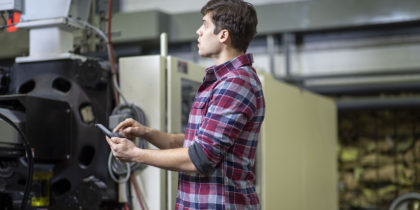
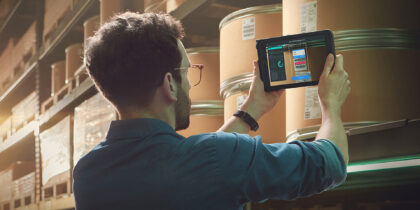
For decades, paper has been ingrained in the daily operations of manufacturing, from work orders to checklists and reports. This heavy reliance on paper carries a significant environmental toll, consuming natural resources and generating waste while also creating added costs and inefficiencies. Mobile devices for manufacturing eliminate the need for paper on the factory floor. Instead of printing out forms for tracking, inspections, and reporting, factory workers can now complete these functions digitally, using Samsung Knox Capture and partner applications to turn devices into high-performance barcode scanners, enabling rapid and accurate information input. Workers on site visits can likewise handle equipment inspections and maintenance paper-free.An added benefit: digital records improve accuracy and accessibility, while making data easier to share, update, and analyze.
More information, less waste
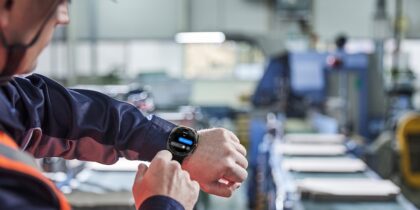
Many of today’s smart mobile devices are designed to integrate directly with a factory’s digital ecosystem. These devices connect with central systems, IoT sensors, and analytics platforms, enabling real-time data exchange. As a result, digital data captured is instantly available for analysis.
With improved intelligence, manufacturers can more easily identify areas of waste, whether it’s excessive energy consumption by a specific machine, recurring material defects, or inefficient process bottlenecks.
Manufacturers can also react faster to problems, preventing minor issues from escalating into significant waste events. This leads to more precise resource allocation, ensuring that energy, raw materials and water, are used exactly where and when they’re needed, minimizing excess.
Built to last, better for the planet
In the demanding environment of a factory floor, where drops, dust, water, and extreme temperatures are common, standard devices simply don’t last. This leads to frequent replacements, increased costs, and a growing stream of electronic waste.
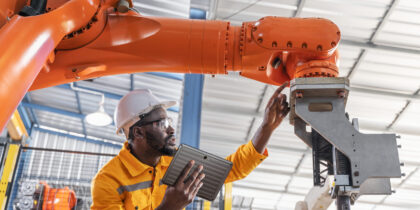
Samsung’s rugged line offers key sustainable advantages. Engineered to withstand the harsh conditions of industrial use, these devices have been put through extensive MIL-STD tests1 for durability including repeated drops, vibration, extreme temperatures and prolonged immersion. In addition, Samsung’s rugged mobile devices feature a longer production cycle and eight years of OS and security support, significantly reducing the need for frequent replacements. This translates into less energy consumed in the production of new devices, fewer raw materials extracted, and a smaller environmental footprint.
The bottom line: Investing in durable, long-lasting mobile technology for manufacturing isn’t just a smart financial decision, it’s a tangible commitment to reducing waste and protecting the environment.
Ready to transform your manufacturing operations with sustainable, smart technology? Explore Samsung’s rugged mobile devices and discover how going paperless, optimizing data, and investing in durable solutions can drive efficiency, reduce waste, and boost your bottom line. And sign up for INSIGHTS: Manufacturing, a monthly update.
1. Disclaimer: These devices passed military specification (MIL-STD-810H) testing against a subset of 21 specific environmental conditions, including temperature, dust, shock / vibration and low pressure / high altitude. Real world usage varies from the specific environmental conditions used in MIL-STD-810H testing. Samsung does not guarantee device performance in all extreme conditions. Please see the in-box Quick Sales Guide.