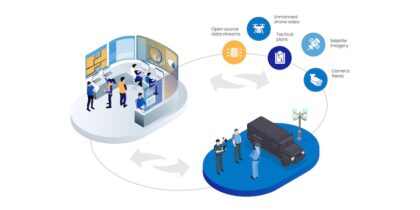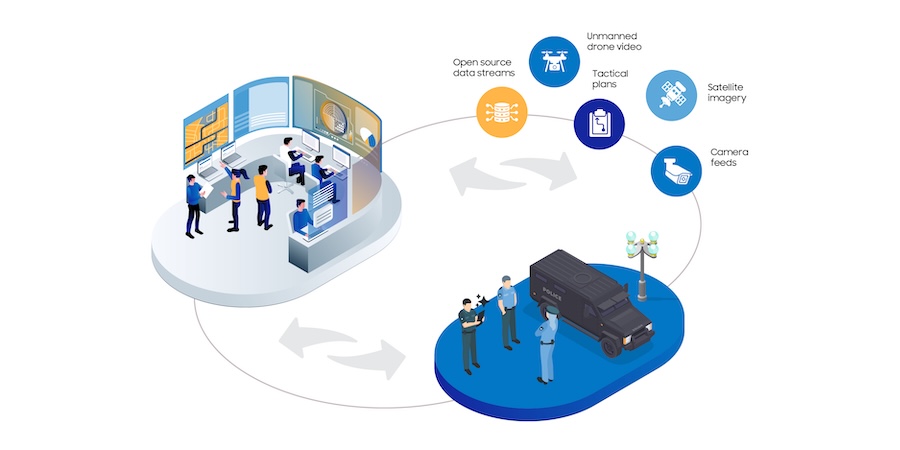
When officers get separated from their car, which happens almost on every call, connectivity is crucial. Mobile devices are the vital links between officers in the field and the situational awareness that a real-time crime center (RTCC) provides. A mobile-empowered RTCC ensures a two-way connection built to rapidly capture, analyze and feed critical information to and from the field when it matters most.
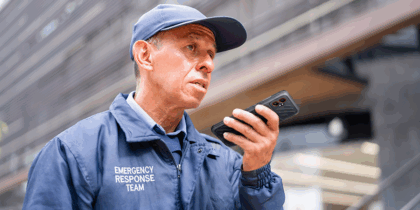
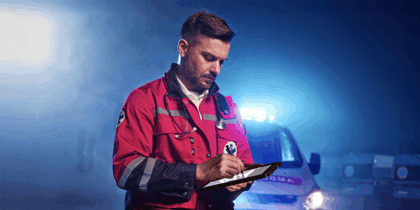
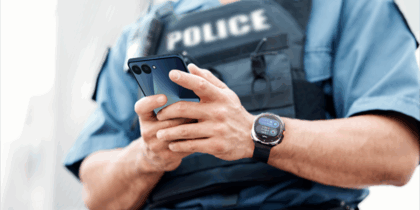
Mobile devices, including smartphones, tablets and wearables, instantly give officers on the scene real-time information, images, video, maps and more. At the same time, these devices share details captured on-site, plus location information and even biometrics, back to the RTCC. The result is immediate, visual updates that enhance awareness and responsiveness.
Better awareness leads to faster clearance rates
RTCCs are proven accelerators for investigations and apprehensions. By design, they enable and enhance:
- Live intelligence to the field, without information overload
- Faster communication and coordinated response
- Augmented situational awareness
- Operational efficiency and evidence integrity
- Community safety and trust
What makes RTCCs so effective is the broad range of real-time data sources they can draw on, including security cameras, license plate readers, gunshot detection systems, GPS trackers and input directly from officers in the field. They can also incorporate historical data, such as local, regional and national crime metrics or details about individuals and locations.
This wealth of information enables analysts and commanders to clearly see everything related to an incident as it happens. RTCCs are also useful for post-event investigations, enabling detectives, analysts, and supporting personnel to identify key pieces of data that might have taken much longer to find.
From days to minutes: the RTCC advantage
An escalated road rage incident provides a prime example, explained Erik Lavigne, a Sergeant with the Fort Worth Police Department and Vice President of Training and Development for the National Real-Time Crime Center Association. In the past, he said, the department would have issued a BOLO for the vehicle involved and potentially apprehended the suspect within two or three days.
The Department’s RTCC played a crucial role in apprehending the offender, Lavigne said: “With a combination of license plate readers and regionalized radio communication with our sister agency, officers were able to locate the vehicle as they were en route. Mixed with dash cam video that we were able to live stream, the result was that we could watch that vehicle be stopped within about 40 minutes, without needing to call in additional resources.”
Turning information into action: the critical role of mobile technology
Maintaining a continuous, two-way flow of information between the RTCC and the field is essential to unlocking the advantages of a modern RTCC. Equipping officers with modern mobile technologies is the key to this connection.
While radios and body-worn cameras inform leadership and provide basic awareness, they often fall short of delivering detailed intelligence to an officer on foot. Mobile devices, including smartphones, tablets and wearables, help close this knowledge gap. They can instantly provide officers on the scene with visual, real-time updates: photos, video, maps, suspect movements and the location of other public safety personnel. At the same time, they give commanders at the RTCC a live view of current situations.
This shift to mobile technology is critical for several reasons:
- Enhanced situational awareness: Providing more complete yet concise information ensures officers know what is going on around them, while reducing the cognitive load in high-stress situations.
- Real-time data loop: Mobile devices feed information, including multimedia details, back to the RTCC in real-time.
- Officer safety: By enabling continuous real-time location data, mobile technologies enable commanders to see where all personnel are in the field and quickly shift resources as situations evolve.
On-device capabilities build awareness and trust
A key advantage of mobile devices, including smartphones, tablets and wearables, is their ability to deliver a productive and data-rich computing experience in the field. Instead of needing to return to the vehicle to enter notes or upload data back to the RTCC, officers have tools that empower them with on-device capabilities, including:
- AI-powered note-taking and transcriptions for faster report creation
- Real-time language translation to improve community engagement
- On-device access to crime-pattern analytics
- Live feeds from drones and robotic camera systems
These aren’t future concepts; these features are available today. Samsung Galaxy devices, for example, have built-in AI that powers accurate speech-to-text, translations and analytics even if cell service is temporarily unavailable.1 With rugged options available, Galaxy smartphones and tablets stand up to harsh conditions and rigorous use, making them ideal for officers in the field.2 They also offer defense-grade security, enabling you to create a CJIS-compliant environment that protects critical data.
Real-time intelligence. Real-world results
Ultimately, RTCCs address the most critical challenge in modern policing: bridging the information gap between headquarters and officers in the field.
While an RTCC centralizes vital data, it’s mobile devices that put this intelligence in each officer’s hands. Galaxy devices are built for the rigors of modern law enforcement, providing a vital link between officers and the information that can enable safer streets and more effective policing.
Learn more about Samsung’s solutions for modern policing here.
1Purchase of AI features may be required after complimentary period. Dates, availability and supported features may vary by app and country. Samsung Account login may be required to use certain Samsung AI features. Samsung does not make any promises, assurances or guarantees as to the accuracy, completeness or reliability of the output provided by AI features. Call Transcript feature requires a network connection to receive calls. Summary feature for Call Transcript is capable of automatically transcribing recorded calls when a certain number of characters is met and is under the character limit. Call recording may not be supported in some countries. Samsung Account login required. Currently available on pre-installed Samsung phones and Voice Record app. Service availability may vary by language or region. Certain languages may require language pack download. Accuracy of results is not guaranteed.Live Translate feature requires network connection to receive call messages. It can translate without network connection once the call messages are received by the device. Samsung Account login required. Live Translate feature is only available on pre-installed Samsung Phone apps and some third-party apps. Service availability may vary by language or region. Certain languages may require language pack download. Accuracy of results is not guaranteed.
2These devices passed military specification (MIL-STD-810H) testing against a subset of 21 specific environmental conditions, including temperature, dust, shock / vibration and low pressure / high altitude. Real-world usage varies from the specific environmental conditions used in MIL-STD-810H testing. Samsung does not guarantee device performance in all extreme conditions.