Creating believable depth on a flat display can be a technical challenge. Human vision is sensitive to inconsistencies in scale, motion and focus. When those cues don’t align, 3D quickly appears awkward and artificial. That’s why most three-dimensional displays have historically required glasses or headsets.
The 85” Spatial Signage SM85HX-P Commercial Display takes a different approach. Instead of trying to simulate depth through software alone, it changes how images are formed inside the display itself. The award-winning technology controls how light reaches the eye, so depth cues stay consistent without requiring any wearable equipment. Here’s how it works.
What you’re seeing in Spatial Signage
When you stand in front of Samsung Spatial Signage, the image appears dimensional immediately. There’s no calibration process or special gear required. Depth is perceptible from the start.
Because the display manages how light is directed toward the eye, it avoids the conflicting visual signals that often make traditional 3D experiences fatiguing or unstable. Instead, the experience is closer to looking through a window than at a surface. Objects appear to occupy space rather than sit on a flat plane, and motion reinforces the effect instead of disrupting it. Depth also stays consistent because it’s not tied to a single viewing position or a narrow field of alignment.
Stability is the key differentiator here. Spatial Signage delivers consistent depth cues because the image formation system is integrated end to end, from panel architecture to processing. Rather than rely on a perceptual illusion, it produces dimension that aligns with how the visual system naturally interprets space.
The technology behind Spatial Signage
Samsung Spatial Signage starts with a high-quality digital display. The image you see begins as a crisp, stable 2D visual, rendered with the same expectations around clarity, resolution and color accuracy that apply to any premium commercial display.
Depth only feels convincing when the underlying image holds up on its own. Soft edges, uneven contrast or motion artifacts would break the illusion immediately. Spatial Signage avoids that failure by making image quality the first requirement, not something corrected later.
A clean, stable image preserves motion integrity and maintains detail before any dimensional cues are introduced. Depth can then extend from a reliable visual surface instead of trying to disguise weaknesses underneath. This is the point where Samsung Spatial Signage separates from standard displays and dimensionality starts to emerge.
When 3D technology enters the picture
With a stable 2D image in place, Spatial Signage can begin shaping how light behaves across the display surface. Then, it’s actually the hardware itself, not the content, that creates depth. Here’s what happens behind the scenes of Samsung Spatial.
The role of the 3D plate
At the center of Spatial Signage is a dedicated optical layer known as the 3D plate. The 3D plate doesn’t generate imagery or apply effects. It redirects how light exits the display, so visual elements no longer share the same plane.
Light guided through the 3D plate creates separation between foreground and background elements. Edges gain clarity, spatial relationships become legible, and objects appear positioned relative to one another instead of compressed into a single surface.
With light already separated as it leaves the display, you don’t need to infer depth or mentally reconstruct space. The image arrives with spatial cues intact, allowing dimensionality to register immediately without exaggerated motion or manipulation.
Precision backlighting
Behind both the image layer and the 3D plate, precision LED backlighting determines how convincingly depth holds together. Brightness and contrast influence how near and far elements appear, anchoring highlights and defining recession.
Consistent backlighting prevents depth from collapsing during motion. Elements move through space rather than sliding across a plane. Contrast remains controlled instead of blooming or flattening as content changes.
The 3D plate and backlighting function as a single system. As a result, light is directed, reinforced and delivered with purpose. That coordination allows Samsung Spatial Signage to maintain depth that feels stable and believable.
Why Spatial Signage works in almost any business setting
Many depth effects lose credibility once the viewer moves. A slight shift in position can flatten the image or distort perspective, breaking the sense of authenticity. A distinct advantage of Spatial Signage is that it doesn’t depend on a fixed viewing point.
As people pass by or approach from different angles, the image is always legible because depth cues are carried by how light exits the display. There is no preferred place to stand or transition point where the effect suddenly engages.
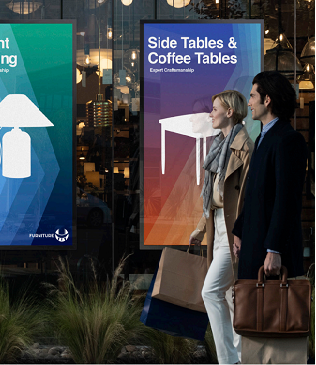
Shared environments raise the bar for depth to behave reliably. Retail floors, lobbies, showrooms and event spaces introduce constant motion, varied sight lines and brief moments of attention. Spatial Signage accommodates those conditions by distributing spatial information across the display rather than concentrating it in a narrow alignment zone. Viewers encounter depth immediately, without instruction or adjustment, allowing the experience to register as natural rather than technical, which instinctually draws eyes to it.
Start with what you already have
Samsung Spatial Signage doesn’t discard existing visuals or require a new library of assets. Images, graphics, GIFs and videos that already communicate clearly in 2D are completely usable. Familiar visuals gain spatial presence as the system separates planes, reinforces contrast and preserves motion clarity. To put it simply, Spatial Signage expands on what existing content can do, rather than demanding something entirely new.
More space, more opportunity
When space is at a premium, Samsung Spatial Signage shines bright. That’s because the revolutionary technology inside actually seems to create more, expanding the canvas for the businesses and organizations employing it. With the added space comes new opportunities to project the brand, display products and capture attention.
Discover the latest Samsung display technology and see what’s possible with a new take on 3D image rendering. Also learn more about how Samsung Spatial Signage is bringing depth and dimension to in-store retail experiences.