Healthcare delivery happens everywhere, from hospital rooms to patient homes. That’s why clinicians need mobile tools like clinical tablets that support fast documentation, communication and access to patient information and data. Providers with access to these healthcare tablets are already seeing big gains in patient care.
A 2025 Survey of Clinicians in U.S. Healthcare Delivery Organizations on Mobile Device Use in Care Delivery found that mobile access management tools are essential for enabling fast, secure authentication and information access.
Tablets like Galaxy Tab A11+ are devices that can help improve bedside care and remote patient monitoring. They ultimately help clinicians document faster, stay connected with patients and maintain continuity of care while improving IT manageability and operational efficiency. Here’s how.
Tablets reach patients where they are
Go to any hospital in the early hours of the morning, and you’re sure to see attending physicians, nurses and support staff doing rounds. As they move room to room, patient to patient, they need access to the latest test results, care notes and patient histories.
A tablet like Samsung Galaxy Tab A11+ makes this easier. The device is ultra-light, weighing just over a pound. In addition, its bright, 11-inch screen with a 90Hz refresh rate and 1920×1200 resolution ensures all records are easy to read in any light.
When a larger screen is needed, the tablet can use the Samsung DeX feature to link — wirelessly in some cases — to a display or monitor, as well as keyboard and mouse. This creates a PC-like interface with multiple windows and folders, all of which are accessible from a taskbar.
Why are tablets better than workstations on wheels?
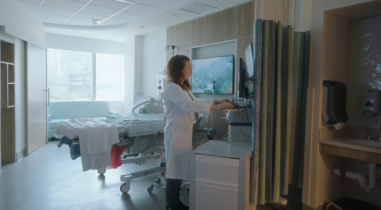
Traditionally, hospitals and clinics employ large, clunky workstations on wheels (WOW) to transport information across patient floors. Such a setup has inherent limitations:
- Size and weight: These expensive portable computer carts are heavy, often weighing tens of pounds, putting physical strain on the person pushing them. They also take up a lot of space in the patient’s room, making an already tight area tighter.
- Battery life: WOWs are also expensive to maintain, and battery time is an issue, particularly in older WOWs, requiring regular recharging and swap-outs in a 24-hour period.
- Infection control: With the WOW constantly rolling through halls and into patient rooms, keeping it disinfected in clinical environments is a constant, labor-intensive job.
- Security and HIPAA violations: Healthcare teams often have to move at lightning speeds, and that may sometimes leave personal information on WOWs visible to unauthorized individuals and open to theft or manipulation, creating HIPAA violations that may result in expensive fines.
That makes WOWs significantly more difficult to use than a lightweight tablet like Samsung Galaxy Tab A11+. The tablet is also able to match WOWs in memory and storage capabilities, with 6GB of RAM and 256GB of storage, which is expandable to 2TB with a microSD card. You can view large files like imaging results, tests and other patient records as easily as on a WOW. And when you’re done in one patient’s room, it’s simple to wipe down and disinfect the tablet before moving to the next one.
How tablets improve and ease the clinical workflow
When it’s time for a patient to leave the hospital or clinic, a doctor, nurse or physician’s assistant needs to create a discharge plan, toggling among multiple resources to move the patient along.
The whole process can be slowed if care providers must wait for a WOW or return to a particular desk or office to get everything done. A purpose-built clinical tablet like Samsung Galaxy Tab A11+, on the other hand, speeds this process by unifying bedside workflows with remote monitoring platforms, reducing device fragmentation and streamlining the workflow across care environments.
A tablet enables healthcare providers to be present with a patient and always equipped with the most up-to-date information. That goes for nurses and doctors on a different floor or taking a much-needed break, too. With a tablet, the provider no longer needs to jump from device to device to keep track of what’s happening.
Expanding remote patient monitoring with tablets
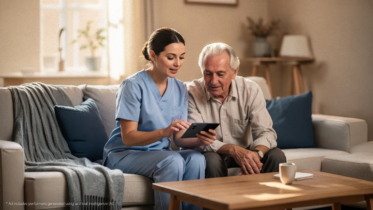
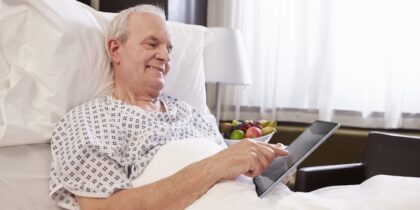
As beds and rooms at hospitals are often in short supply — and patients almost always prefer to recover at home — tablets gain a practical appeal for remote patient monitoring.
When those undergoing treatment or recovery are equipped with remote patient monitoring devices like tablets, they are able to more easily link and share data from Bluetooth-enabled sensors and peripherals with caregivers at hospitals and clinics. This includes pulse oximeters, weight scales, blood pressure cuffs and pacemakers. Data that falls out of safety zones can automatically trigger alerts and medical responders.
Tablet-to-tablet communication happens easily and securely through HIPAA-compliant remote patient monitoring apps, including with videoconferencing and other messaging tools. This enables patients and caregivers to remain in close contact for check-ins, treatment adjustments and emergency responses.
Improving outcomes with IT manageability and operational efficiency
Treating patients in and out of healthcare facilities is challenging at any level. It becomes even more so when IT manageability and operational efficiency struggle to keep up with the needs of both patients and caregivers. Tablets like Samsung Galaxy Tab A11+ can close the gap and ease the pressure on many levels. When integrated smartly and strategically, they also help achieve the highest goal of all: positive patient outcomes.
Learn more about how tablets can help healthcare workers avoid burnout. Also discover how expanding care beyond the hospital’s four walls leads to better patient outcomes in this white paper.