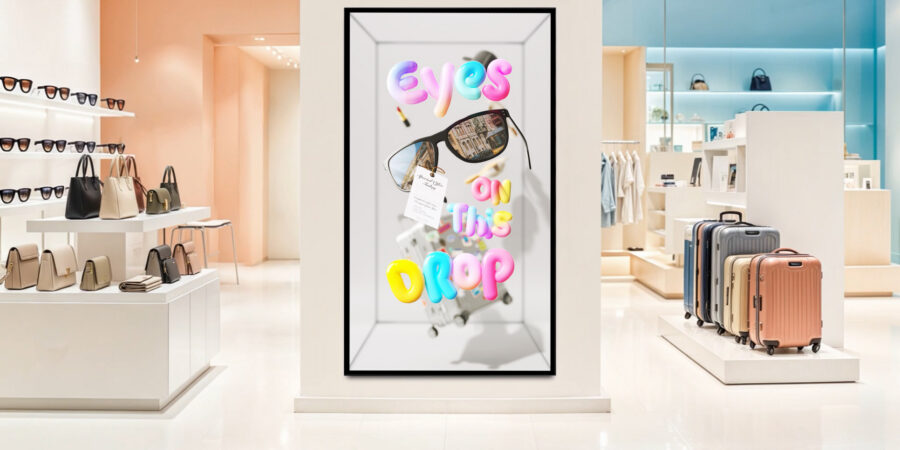
Digital displays have become the indispensable technology of business today. They guide customers through stores, deliver critical information, define brand experiences and carry thoughtful messaging across offices, showrooms and public spaces. But as screens multiply, visuals must work harder to capture attention and motivate action.
Samsung Spatial Signage takes that expectation to a new dimension. Using award-winning 3D technology, it introduces depth and realism that go beyond traditional displays, creating visuals that feel more immersive and alive.
This format doesn’t just stand apart; it stands out, literally. By adding depth and dimensionality to digital content, Samsung Spatial Signage opens new ways for businesses to engage audiences and make messages impossible to ignore. Here’s how.
The pop of Spatial Signage
At first glance, Spatial Signage looks like a standard commercial display. But power on Samsung 32-inch Spatial
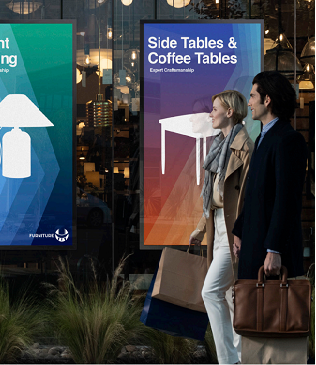
Signage SMHX-P or Samsung 85-inch Spatial Signage SMHX, and that changes fast. Lifelike 3D visuals introduce depth and dimension, making objects appear to extend beyond the screen. The result is a visual “pop” that grabs the attention of passersby.
The experience is glasses-free, too, requiring no headsets or special viewing equipment. Anyone who walks by can interact with it immediately. That accessibility is part of why the response tends to be organic; people stop because the visual display earns it.
Technology that defies depth
The visual impact of Spatial Signage comes from 3D imagery and video, created from converted 2D assets or native 3D content. Objects appear to extend up to 3 1/2 feet beyond the screen, even though the display itself is just 2 inches deep. Visuals feel expansive without requiring additional physical space.
The depth-to-footprint ratio allows businesses to introduce a bold, future-forward visual experience while preserving clean sight lines and working within existing design constraints. No custom enclosures, no structural changes, no compromises on the surrounding environment.
Designed to scale
Immersive displays often stall after pilot projects because deployment becomes a bottleneck. Spatial Signage avoids that trap by pairing advanced visual capabilities with a deployment model built to scale and designed to fit cleanly into existing signage ecosystems.
Spatial Signage mounts and installs like a standard digital display, requiring no special environmental tuning, custom enclosures or elaborate configuration. Deployment timelines are short, and approvals move faster across IT, facilities and design teams. For businesses managing multiple locations or rotating displays across spaces, Spatial Signage fits into existing deployment models rather than forcing teams to invent new ones.
Turning existing assets into immersive experiences
The value of Spatial Signage depends largely on how easily content can be created, adapted and updated. Spatial Signage lets businesses start with visuals they already have and build immersion incrementally rather than from scratch.
Transforming 2D assets into immersive marketing
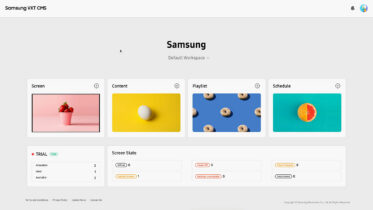
Samsung Spatial Signage may feel like a revolutionary marketing technology, but it’s incredibly easy to implement, with no need to overhaul creative libraries or reinvent campaigns. Existing 2D assets, including images, graphics, logos and video, can be transformed into immersive content with added depth and dimension. That keeps production timelines realistic and experimentation accessible, particularly when paired with Samsung VXT, a cloud-based content management system.
A 3D canvas also enables you to expand your campaigns and partnerships. The new opportunities dimensional experiences bring to advertising formats and messaging appeals to partner brands. The ability to showcase them in 3D can be a compelling differentiator.
Where Samsung Spatial Signage benefits stand out
Samsung Spatial Signage earns its place when visual impact connects directly to business outcomes. This alignment shows up most clearly across several environments:
Retail counters and showrooms
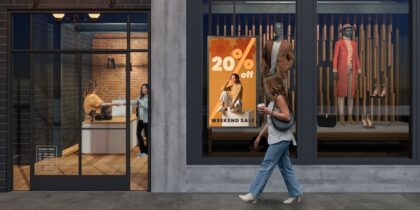
The 32-inch Spatial Signage SMHX-P is built for close-up environments where product details guide decisions. On a retail counter or shelf, it gives shoppers a 360-degree view of a product in full 3D rotation, showing every angle without requiring them to pick it up. For categories like beauty, footwear, accessories and consumer electronics, that kind of visibility helps close the gap between interest and purchase.
Out on the showroom floor, the 85-inch Spatial Signage SMHX can go even further, presenting products at or near life size, with objects appearing to extend up to 3 1/2 feet beyond the screen. That presence commands attention across a floor rather than at a counter, making it effective for product launches, premium collections and brand storytelling that needs space to achieve full impact.
Restaurants, cafes and pubs
Food and beverage service environments benefit from the same close-proximity impact. Promotional content, featured menu items and limited-time offerings gain a visual presence that flat, 2D imagery cannot match, presenting food and drink items in 3D that viewers can seemingly reach out and grab.
That makes Spatial Signage particularly useful for promoting specials, new and seasonal items and pop-up events. Samsung VXT also allows them to create a 3D-friendly menu that fits the format and captures attention, while also driving the brand image and messaging more immersively than ever.
Corporate offices and experience centers
In corporate environments, Spatial Signage serves both internal audiences and visitors. Messaging needs to inform audiences while reinforcing brand identity for visitors, partners and prospective employees. Spatial Signage adds a sense of polish, pop and intention, presenting ideas and achievements with dimensional clarity that feels purposeful rather than decorative.
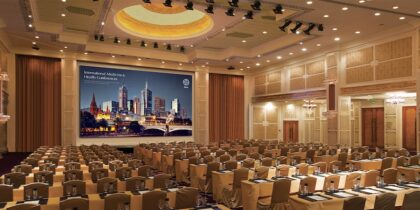
The 85-inch display works well in large experience centers, where immersive visuals make concepts more tangible and innovation narratives more credible. In smaller briefing rooms and corporate offices, the 32-inch display can deliver greater power and clarity to brand stories and messaging, adding depth and dimension. Concepts feel more tangible; innovation narratives more credible, and brand stories more closely aligned with a forward-looking culture.
Live events and temporary installations
Events demand immediate impact under tight timelines. Both the 32-inch and 85-inch Spatial Signage mounts and deploy like standard commercial signage, keeping installation straightforward even in temporary settings.
Once live, the impact is hard to miss. At trade shows, pop-ups and product reveals, Spatial Signage draws attention and holds it longer — an advantage in crowded, competitive environments. Campaigns gain visual distinction while remaining portable and reusable across multiple events.
Truly a new dimension
With lifelike 3D imagery, Spatial Signage goes beyond displaying information. It shapes perception, creates moments of engagement and delivers brand experiences that feel modern, intentional and future-forward. Adding dimension to visual communication deepens brand presence and elevates how audiences connect with and respond to what they see.
Explore the many ways Samsung Spatial Signage can bring your brand to life. Also learn how the technology works to present 3D images and video glasses-free.