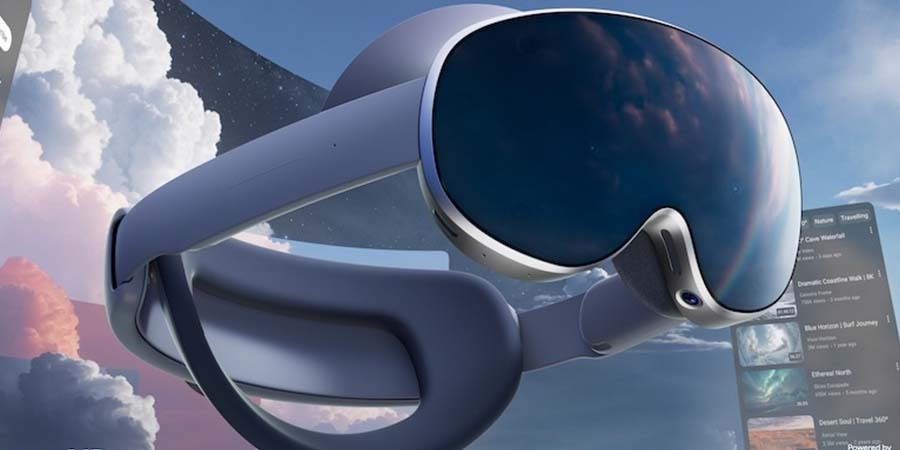
Extended reality (XR), comprised of virtual reality, augmented reality and mixed reality, has moved out of the lab and into the workplace. Enterprises are deploying screen-free technology to train employees, enable hands-free work and plan physical spaces with greater efficiency and accuracy.
And it’s happening across the board. Industries like healthcare, manufacturing and retail are witnessing a transformation of their operations with immersive XR, especially when paired with AI-powered interaction and Android-based tools that make deployment easier to scale.
Here’s how enterprises are moving XR from experimentation to execution to drive measurable impact.
Bringing XR to business
New technologies often arrive wrapped in consumer buzz, but true technological shifts take shape when businesses begin adopting and applying them. That’s because business applications put very different demands on a technology than consumers do, and often at much larger scale.
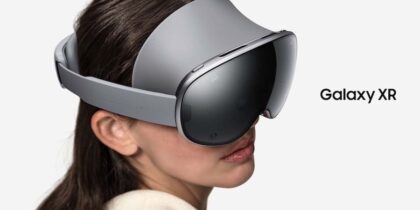
Samsung is driving this change with Galaxy XR, which it co-developed with Google and Qualcomm specifically for enterprise environments. In this context, XR needs to perform consistently and demonstrate clear value over time. For IT leaders and operations teams, that includes deployment, ongoing management and long-term support of the user experience. In other words, XR should fit into existing workflows and open the door to new ones.
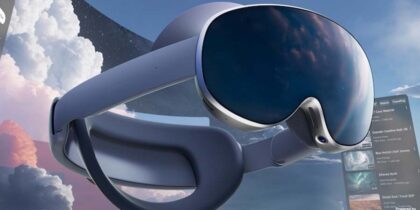
XR hardware has to support that, too, and be ready for extended sessions. That’s why Samsung designed its XR headset with an ergonomic shape and soft-touch fabric that rests lightly on the face. Same goes for the software, both when it comes to 4K OLED visuals and natural interaction through hand gestures, eye tracking and voice commands.
In an enterprise environment, that also means evolving beyond standalone experiences. Built on Android XR, the headset slots right into the Galaxy ecosystem of applications and features that enterprises already rely on for deployment and device management at scale. AI-powered interaction adds to this, supporting contextual search and conversational control and allowing information to surface as work progresses across a multitude of industries.
Healthcare: Immersive training without real-world risk
Healthcare training leaves little room for approximation. Clinical teams need experience before entering high-pressure environments, but many scenarios are difficult to practice in
real settings. It’s a classic chicken-and-egg challenge that clinicians and training leaders have been navigating for decades.
Galaxy XR gives healthcare organizations a way to train for complexity without putting patients at risk. It creates immersive environments that allow clinicians to practice procedures and work through decision points before stepping into live settings. The headset’s 4K, OLED visuals, in particular, lend themselves to accurate anatomical representation and spatial awareness.
The hands-free interaction of Galaxy XR allows actions and reactions to unfold in real time, while gesture and voice control let clinicians move through scenarios naturally without having to break posture or concentration to manage a device. Spatial audio plays a role, too, reinforcing situational awareness by mirroring sound cues in real clinical environments.
Gemini AI levels this up further with another layer of support. Context-aware assistance allows information to surface as scenarios unfold, giving trainees access to guidance while remaining fully engaged in the experience. Questions can be asked verbally, and responses appear within view. The Circle to Search feature enables XR healthcare users to call up further support and information on anything in the in the virtual or real-world landscape around them.
For healthcare organizations training teams across multiple locations, immersive XR also enables greater consistency. The same scenarios can be delivered with shared expectations and repeatable structure, so clinicians are able to build skills within a common framework.
Manufacturing and utilities: Hands-free work in active environments
In manufacturing and utilities, people and technology create value while work is in motion. Access to information is certainly important, but continuity usually takes precedent. Once execution begins, stopping to consult a screen or step away from the task introduces the potential for delays and hazards.
With Galaxy XR, technicians can reference procedures and instructions while remaining engaged with their equipment and surroundings. Information becomes part of the workflow rather than a separate step that pulls attention away. Furthermore, as conditions change, the device provides context-aware assistance to help technicians work through questions and challenges in a natural way. Remote collaboration and expert guidance might also be layered into active work without disrupting execution.
Across production floors and field operations, consistency matters as much as speed. Variations in how work is performed introduce risk, rework and downtime. By keeping execution aligned while work stays in motion, Galaxy XR helps manufacturers and utility providers apply expertise more evenly across sites for safer and more reliable operations.
Retail: Planning physical spaces before permanent decisions
Retail layouts and merchandising strategies often move from concept to execution under tight timelines. Here, the challenge isn’t imagination, but confirmation. Retailers want to
understand how their ideas will translate into real spaces before committing resources. That makes retail one of the clearest industries in which XR moves from interesting to useful.
Galaxy XR allows retail teams to step inside plans rather than interpret them from flat designs, thanks to its ability to spatialize 2D imagery into 3D. Explore an entire store environment virtually to gain a clearer sense of flow, sight lines and customer movement.
Merchandising teams can walk a virtual aisle to evaluate product placement before fixtures arrive on site. Store planners may test alternative layouts to see how traffic flows around seasonal displays or high-margin categories. That makes concepts more tangible earlier in the process, which can help highlight issues and opportunities before a buildout.
Spatial clarity may also change how your team collaborates. Decisions no longer rely on static mockups or abstract discussions. Adjustments can be reviewed in context, and alignment happens faster because everyone is looking at the same environment.
A natural fit for a digital world
What stands out across these use cases isn’t necessarily immersion itself, but how naturally Galaxy XR is able to integrate into high-stakes environments where continuity, focus and decision-making converge in real time.
In some, it creates space to prepare before performance begins; in others, it enhances work already underway. And in planning, it shows how abstract ideas will behave in the real world before they take physical form.
As enterprises continue to apply XR more deliberately, the conversation shifts away from experimentation and toward transformation. And ever more, there are models across industries demonstrating just that and becoming the new leaders.
Learn more about the value of Galaxy XR for your business and speak to a Samsung Business expert today.