Hospitals face a difficult challenge: how to immediately create a welcoming, comforting atmosphere in a place where many people arrive feeling anxious, uncomfortable or in pain. It’s an important question, especially as patient expectations continue to rise. A 2025 survey by Tebra, a cloud-based digital healthcare platform for independent medical practices, found that 65% of people would change doctors or practices for a better overall experience, up sharply from 10% in 2024.
To improve the patient experience, hospitals rely on clear, accessible communication, which also supports better health outcomes and strengthens organizational visibility. Digital signage has become a central part of that communication strategy. According to research, the global healthcare digital signage market was valued at $7.5 billion in 2024 and is projected to grow to nearly $19.7 billion by 2033, reflecting the expanding role of digital displays across care environments.
That growth is being driven by the tangible, day-to-day value digital signage delivers inside healthcare facilities. From guiding patients and visitors to reinforcing health messaging and brand trust, healthcare digital signage solutions support communication at every stage of the care journey. They offer hospitals a range of benefits, including these seven:
1. Guide guests to their destinations
Hospitals are large, busy environments, and they can be intimidating to navigate, especially when patients are trying to arrive at appointments on time. Staff members are frequently stopped for directions, pulling them away from clinical and operational responsibilities. Over time, those interruptions add up, reducing efficiency and increasing costs.
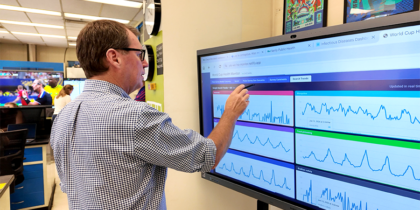
Digital wayfinding signage helps ease that burden by giving visitors clear, self-guided directions. Interactive displays like the Samsung WAF Series allow patients and guests to search destinations, view step-by-step directions and interact with content directly on a responsive touchscreen. For broader visibility in lobbies and high-traffic corridors, large-format displays such as the QPDX-5K Series 105″ provide a wide, seamless viewing experience that can be seen clearly from multiple angles without distracting borders. Together, these displays act as intuitive visual anchors for patients, visitors and staff alike.
When paired with a dynamic cloud-based content management platform for digital signage, such as Samsung VXT, healthcare organizations can update wayfinding content instantly, whether across a single display or an entire facility, to ensure information stays accurate as layouts, departments and schedules change.
2. Deliver personalized patient care
Patient education and engagement are top priorities for hospitals. When patients better understand their health needs and feel actively involved in their care, providers are more likely to deliver positive outcomes. As a result, healthcare organizations have placed greater emphasis on patient-centered care and shared decision-making, approaches that also help improve the overall patient experience and reduce repeat admissions.
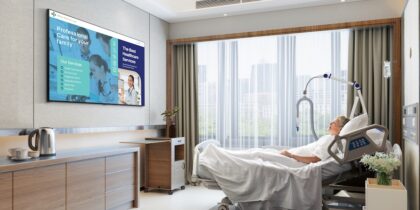
Digital displays help reimagine that patient room experience. Traditional paper notices and dry-erase boards require frequent manual updates throughout a patient’s stay. Digital screens, by contrast, allow healthcare organizations to
personalize and update information in real time, including care instructions, room phone numbers, vital details and the names and photos of the care team.
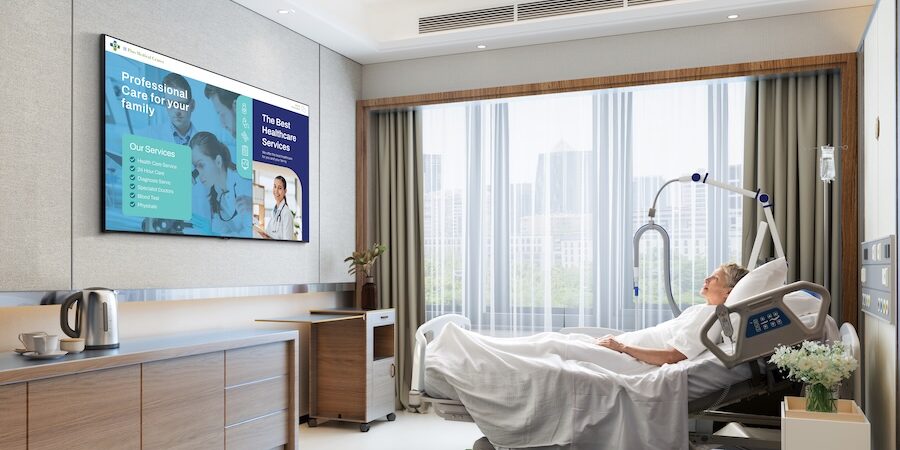
Patient rooms equipped smart TVs also help create more engaging, comfortable environments. Patients can watch educational videos tailored to their condition or upcoming procedures, while still enjoying access to their favorite shows and movies. Samsung displays such as the HCU703 Series 75” and HCF800 Series 32” support personalized patient education, entertainment and communication, helping improve patient satisfaction while enabling remote management and secure integration of electronic health records (EHR).
Both displays run on Samsung Lynk Cloud, a cloud-based platform that provides centralized management for guest- room TV, content distribution and streaming — including support for Google Cast and Apple AirPlay — along with device control and data analytics. Security is built in through Pro:Idiom encryption and Samsung Knox, helping protect patient information and maintain compliance across the care environment.
3. Reduce waiting room anxiety
Waiting is difficult under any circumstances, but it can be especially stressful for patients who are unwell or for family members awaiting updates during a medical procedure. Digital displays help ease that stress by showing expected wait times on the screen and sharing content that is both informative and engaging, giving visitors a clearer sense of what to expect.
In surgical waiting rooms, digital signage can provide real-time status updates for families using assigned numbers rather than patient names, helping protect privacy. Loved ones can see when a patient enters surgery, how long the procedure is expected to take and when they have been moved to recovery. By keeping information current and visible, this signage helps reduce uncertainty for families while allowing clinical staff to stay focused on patient care.
Smart signage such as the 32″ EMDX Series Color E-Paper QHD Smart Signage also supports a more streamlined waiting room experience. Placed in lobbies or waiting areas, these displays can assist with appointment check-in, provide maps to help visitors find their destination and surface status updates in a clear, easy-to-read format. Waiting room signage can also share practical local information, such as nearby dining options, news, traffic and weather, helping patients and families feel more informed and at ease during their visit.
4. Communicate with visitors in real time
Hospitals need to communicate a wide range of information to patients and visitors, from urgent safety announcements to service updates, events and general wellness messaging. Delivering that information clearly and consistently is critical in environments where conditions and priorities can change quickly.
This represents a significant step forward from traditional paper bulletin boards, where notices can become outdated, damaged or lost among a sea of flyers. Digital signage allows hospitals to manage information dynamically, ensuring messages stay current and visible across the facility.
With digital signage solutions, administrators can control what information appears, when it appears and where it is displayed. Updates can be made instantly, and in emergency situations, real-time safety alerts can be pushed across screens. During an infectious disease outbreak, for example, when guidance from the CDC is evolving rapidly, digital signage helps ensure visitors and staff see the most up-to-date protocols and recommendations.
Lobby displays can also play a role in telling the organization’s story. Supersized dynamic displays featuring staff profiles, patient testimonials and facility highlights help build trust and confidence, while also answering common questions about services, amenities and innovative care practices.
In hospital cafeterias, digital signage simplifies menu management and improves the dining experience for staff, patients and visitors. With digital menu boards, such as the Samsung QMC Series 43″ Commercial Displays, teams can instantly update daily specials, remove sold-out items, adjust pricing and highlight nutritional information, all
without relying on chalkboards or reprinted materials. The result is accurate, visually clear menus that are easy to manage centrally while keeping information fresh throughout the day.
5. Celebrate your donors and increase revenue
Hospitals depend on the generosity of donors to advance care, expand services and invest in new technologies.
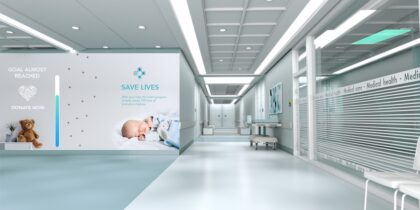
Large-format displays such as Samsung The Wall offer a powerful way to recognize those contributions. Positioned in prominent areas like main entrances or lobbies, the modular microLED display can showcase donor names, stories and milestones on a striking, larger-than-life canvas that immediately captures attention. That visibility not only honors supporters but can also help encourage future giving.
For organizations seeking a streamlined, out-of-the-box solution, The Wall All-in-One delivers the same immersive impact in set sizes with pre-assembled mounting brackets and background plates, simplifying installation and reducing deployment complexity.
Beyond donor recognition, digital displays can also support revenue-generating initiatives across the facility. Hospitals can promote services, highlight affiliated clinics, spotlight gift shop offerings or feature cafeteria specials. Some organizations may even choose to offer advertising space to local businesses, creating mutually beneficial partnerships while generating incremental revenue from existing digital infrastructure.
6. Share information across hospital staff
Digital signage helps clinical teams share critical information quickly and consistently, without relying on paper charts or manual handoffs. For example, a patient information screen positioned outside a room can display essential alerts such as allergies, fall risk or isolation status. This supports faster decision-making while helping reduce the risk of error and maintain HIPAA compliance.
At nurses’ stations, digital signage can surface operational information at a glance, including who is currently on duty, upcoming shift schedules and patient assignments. These displays support smoother coordination across teams, helping staff stay aligned in fast-paced environments where timely communication is essential.
7. Increase the speed of diagnosis
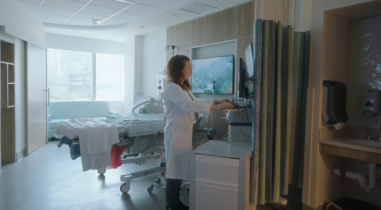
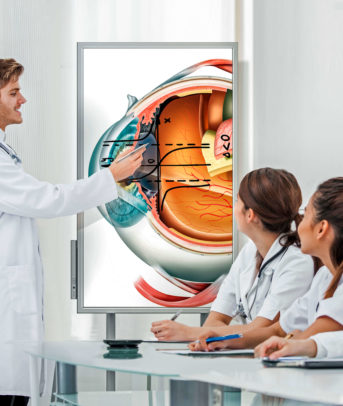
Digital displays also play a critical role in accelerating diagnosis and clinical review. Widescreen, high-resolution monitors such as the 34 Inch ViewFinity S6 S65TC provide clinicians with an expanded visual workspace, making it easier to review complex information side by side. From X-rays and CT scans to electronic health records (EHRs), a larger canvas helps physicians analyze imaging and data more efficiently and with greater precision.
By reducing the need to toggle between multiple windows or systems, clinicians can save valuable time and focus more fully on patient care. Interactive displays further enhance collaboration by allowing physicians to digitally annotate medical images. These annotations can be shared instantly with care teams or provided to patients, supporting clearer communication and faster clinical alignment.
Enhancing the healthcare experience
Across healthcare facilities, digital signage gives patients and care teams immediate access to timely, relevant information that helps support smoother workflows, clearer communication and a more reassuring care environment. The result is a stronger patient experience, improved operational efficiency and greater clinician satisfaction, all of which can contribute to better outcomes across the organization.
To learn more about the impact of digital signage in healthcare, join Samsung at HIMSS 2026, taking place March 9–12 in Las Vegas. Visit booth #4335 to see how Samsung display solutions are helping healthcare leaders transform communication, collaboration and patient experiences across the care journey.