When restaurants grow with success, they come face-to-face with a host of new challenges and hurdles to overcome. For example, the systems and workflows that worked great for a single restaurant struggle to keep up with several locations.
One of the most common issues is balancing the speed of service with the need for consistency. Small differences in how orders are taken, processed or fulfilled may make it hard to deliver the same standard of service across the brand.
A mobile point-of-sale (mPOS) system helps bring structure to the growth phase. When ordering and payment capabilities extend beyond a fixed counter or register, staff is able to meet guests where they are while staying connected to the big picture. Here’s how.
Keep service moving as demand increases
Speed of service often comes down to how easily staff can move through the ordering and payment process during a busy shift. When transactions are tied to a fixed terminal, even well-run teams might run into slowdowns as lines build and servers move back and forth to complete orders and print bills.
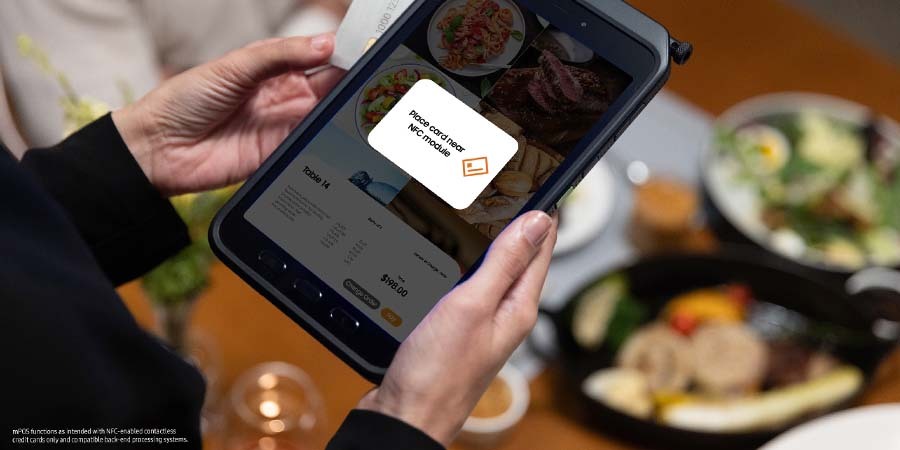
The mPOS systems on tablets like Samsung Galaxy Tab S11 and Galaxy Tab A11+ change that flow. Orders can be taken table side, and payments completed on the spot. This kind of flexibility eases pressure at the counter at fast casual and quick-service environments. In full-service settings, it allows servers to stay longer with guests.
The result is a service model that feels less rushed and more responsive — putting more attention on the customer — without requiring a redesign of the restaurant or business operations.
Establish consistency across every location
Proper training is essential to maintaining consistency across a growing footprint, but it’s not the only factor. Technology also plays a central role in ensuring that menus, pricing and workflows remain aligned as teams and locations expand.
Cloud-managed mPOS platforms allow operators to centralize updates and push them to every device in real time. When a menu item changes or a promotion launches, those updates appear consistently across locations without relying on manual adjustments at each store. This level of coordination supports a more consistent guest experience and reduces errors.
A mobile POS system also reinforces standardized workflows, giving staff a consistent structure and procedure for how orders are entered and processed while still allowing for location-specific nuances where needed.
Turn data into day-to-day decisions
With expansion comes a greater need for visibility. Instead of focusing on a single set of daily sales numbers, operators must examine data from multiple locations, each with its own idiosyncrasies. mPOS platforms connected to cloud-based systems provide a more immediate view into the total performance.
With mPOS platforms, operators are able to monitor transaction trends, identify shifts in demand and compare how different locations are performing throughout the day. That access to real-time information makes it easier to respond in the moment. Staffing adjustments, menu changes and promotional decisions can be informed by what is happening across the system rather than relying on reports that are days or weeks old.
Over time, operations become more streamlined because decisions are grounded in current data and a holistic view rather than guesswork.
Support staff with tools designed for the floor
When it comes to choosing an mPOS system, it needs to be practical in a restaurant environment. Sometimes that requires more durability than usual. Rugged solutions like Samsung Galaxy XCover7 Pro and Galaxy Tab Active5 and Tab Active5 Pro are designed to handle bumps, drops and spills. This translates into fewer interruptions and more consistent performance during busy service periods.
Another bonus for growing restaurants is the on-the-spot training for using an mPOS. With guided procedures and intuitive interfaces on tablets, new hires can learn the system quicker and get on the floor sooner, which is especially important in high-turnover industries like restaurants.
Adapt to different formats and service models
Franchise growth often involves expanding into a range of formats, from compact urban locations to larger suburban footprints with curbside and drive-up demand. Each environment introduces its own operational considerations.
A mobile POS system provides the flexibility to adapt without requiring entirely different technology stacks. The same core system can support table side ordering in one location and line-busting or curbside service in another.
This adaptability allows brands to maintain consistent operational workflows while tailoring the guest experience to each setting. It also gives operators room to test and refine service models as they grow, without being locked into a single approach.
A connected approach to scaling operations
There’s more to expansion than adding new locations. Operators must ensure that staff stay connected and guests receive the same brand experience across the board.
mPOS systems allow restaurants to grow without losing the qualities that made the original location successful: Service remains efficient, operations stay aligned, and teams have tools that support how they actually work. For operators focused on franchise expansion, that balance between flexibility and control is a critical factor in turning growth into long-term success.
Discover more about how mPOS systems are becoming a point of distinction in hospitality. And see further features of Samsung for Point of Sale that help empower franchise expansion.