Brick-and-mortar retail remains the backbone of commerce. Even as digital sales continue to grow, e-commerce still accounts for just 20.5% of total retail sales, according to eMarketer, leaving the majority of purchases happening in physical stores.
That scale comes with opportunity and a challenge. Shoppers arrive in stores with expectations shaped by digital experiences: rich visuals, dynamic content and information that’s easy to absorb immediately. Many in-store environments, however, still rely on static signage that struggle to capture attention or communicate value.
To better engage shoppers, retailers are rethinking how visual content shows up on the floor. One emerging approach is autostereoscopic signage, which introduces depth and lighting effects to create a stronger sense of dimension without requiring headsets or glasses.
Enter Samsung’s Spatial Signage commercial displays, which are designed specifically to deliver this kind of visual impact in real-world retail environments.
What is Samsung Spatial Signage?
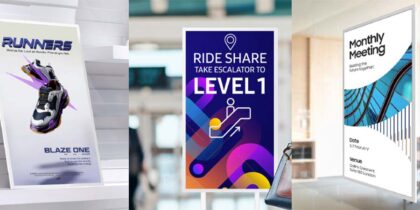
The Samsung 85” Spatial Signage SM85HX-P Commercial Display transforms standard 2D images and video into 3D visual experiences, all without the need for special glasses or additional hardware or software. For retailers, this means familiar content formats can feel more engaging and more immediate, whether they’re showcasing a new product launch, highlighting promotional items or featuring user-generated content that shows merchandise in use.
The effect is achieved through a combination of optical and lighting innovations built directly into the display. A 3D plate inside the panel introduces depth, while precision LED backlighting enhances contrast and brightness to reinforce the sense of dimension. Although the display itself measures just two inches in depth, the resulting spatial visuals can appear to extend up to three and a half feet forward from the screen.
For viewers, the result feels less like watching a flat display and more like looking through a window. This creates a stronger visual presence that draws attention without asking shoppers to change how they browse.
The value Spatial Signage brings to the shopping experience
Samsung’s Spatial Signage displays enhance the in-store experience in several practical ways, starting with how shoppers notice and engage with content.
Capturing and holding attention
Retailers already know that motion draws the eye. That’s why product videos have become a standard online and why video screens are increasingly common on the sales floor. Spatial Signage builds on this foundation by adding depth cues that make content feel more present and harder to ignore.
Movement attracts initial attention, while the 3D effect helps sustain it. It encourages shoppers to pause, look closer and absorb more information before moving on.
Turning 2D content into 3D without complexity
A major barrier to advanced visual merchandising has traditionally been production effort. Samsung’s Spatial Signage displays are designed to remove that friction.
Using standard 2D images or video, retailers can generate spatial content without specialized software or 3D design expertise. Through a content management system like Samsung VXT, retailers can easily upload content and apply depth, lighting and dimensional effects automatically.
VXT also gives teams creative flexibility through templates, animations, text tools and integrations with third-party design applications. This makes it significantly easier to produce content that feels on-brand and dynamic without slowing down campaigns.
Creating richer product stories
Spatial Signage provides retailers with more ways to show products in context and in detail, whether that’s highlighting craftsmanship, emphasizing materials and textures or revealing movement that flat images can’t convey. For categories like apparel, accessories or consumer electronics, these details help shoppers better understand what they’re seeing before they ever touch the product.
How digitizing retail experiences boosts ROI

Explore customer behavior with and the operational benefits of a complete digital retail ecosystem. Download Now
Retailers can also extend these stories by incorporating user-generated content, social posts or real-world use cases to connect with customers further.
Expanding space without expanding the footprint
Physical space is one of retail’s most expensive constraints. Samsung Spatial Signage helps retailers make more of the space they already have. These displays can make environments feel less flat and more expansive without changing floor plans or adding square footage. The result is a store experience that feels more open and engaging, even during high-traffic periods.
Increasing the value of partner and advertising content
Many retailers monetize in-store screens through brand partnerships and advertising placements. Samsung Spatial Signage raises the value of those placements by making partner content more visually compelling and harder to overlook.
For advertisers, this means stronger engagement and a higher likelihood that messaging resonates. For retailers, it creates more appealing opportunities for paid partnerships and cross-promotion, turning displays into revenue-generating assets rather than static fixtures.
Standing out in a crowded retail environment
Brick-and-mortar retailers aren’t just competing with e-commerce but competing for attention in increasingly busy spaces. From the moment shoppers pass a storefront to the time they decide whether to linger, every visual touchpoint matters.
Samsung Spatial Signage gives retailers a way to break through that noise. By adding depth and lighting to familiar content, the spatial display helps capture attention faster, hold it longer and communicate product value more effectively. It’s about using visual technology to make in-store experiences work harder by turning displays into tools for engagement, storytelling, and measurable impact.
Learn more about the Samsung Spatial Signage here.