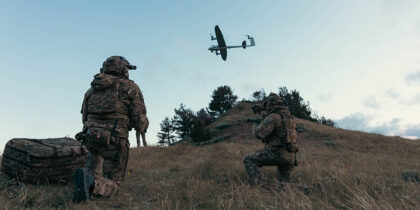
The military command center is no longer defined by a physical location. It exists wherever data becomes action, from centralized command hubs to the tactical edge.
Today’s operators are navigating an ever-growing volume of data across disconnected systems, often in contested environments. To meet these demands, modern command centers are evolving to better support distributed operations, real-time decision-making and cross-domain integration.
As Combined Joint All-Domain Command and Control (CJADC2) priorities accelerate, C5ISR systems are becoming more connected than ever before. But interoperability alone does not create decision advantage. Decision dominance is determined by how quickly information flows from system to operator to action within a unified workflow.
Mobile ecosystems enable that workflow by bringing together live feeds, sensor data and communications in real time to drive faster, more informed decisions across operational environments. This mobile-enabled command model is fueling modern military command and control, helping move decisions to the edge, connect information across domains and secure operations without interruption.
Moving decisions to the edge
Modern command centers are enabling decision dominance at the intelligent edge, and device ecosystems are helping keep operators connected in highly contested environments. Operator-ready, ruggedized devices extend command capability to the edge, placing decision-making in the hands of those closest to the mission.
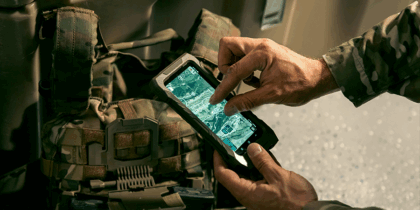
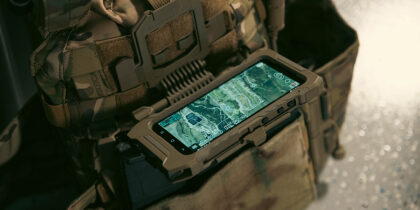
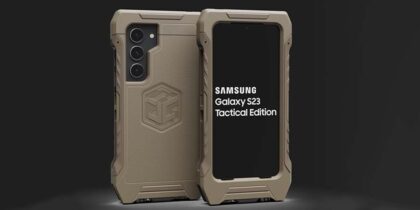
Mission-ready end-user devices extend critical applications, ISR feeds and communications directly to operators, reducing reliance on fixed command posts. Solutions like the Samsung Galaxy Tactical Edition suite of devices are purpose-built with features like dual-layer encryption, tactical radio interoperability, night-vision compatibility and stealth mode to sustain operations in degraded conditions.¹
In environments where connectivity may be disrupted or denied, the ability to process and act on information locally is critical to maintaining operational tempo. On-device applications and processing reduce latency and ensure decision-critical insights remain available without reliance on reach-back capability.
For example, dismounted units can view direct ISR feeds, updated positions and coordinate movements directly from their device, even when disconnected from headquarters elements.
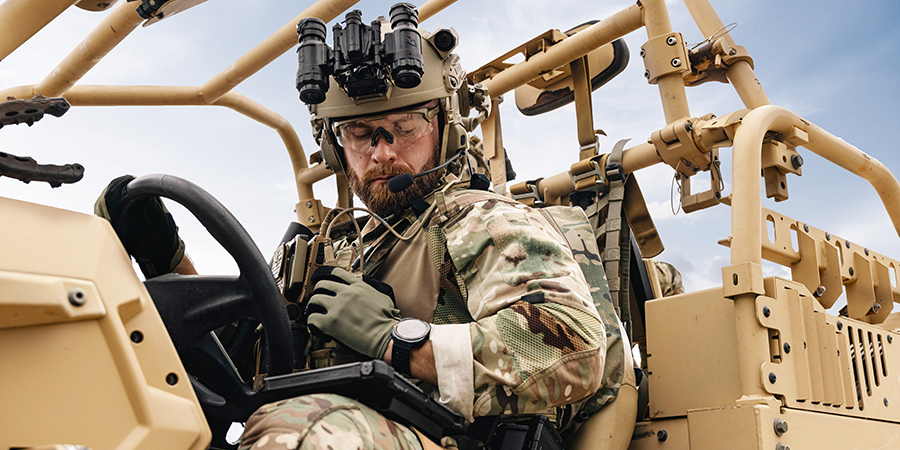
Capabilities like Samsung DeX further extend this flexibility, allowing a mobile device to function as a full workstation. Operators can dock into a command vehicle, analyze data feeds, build a brief and maintain a continuous workflow.²
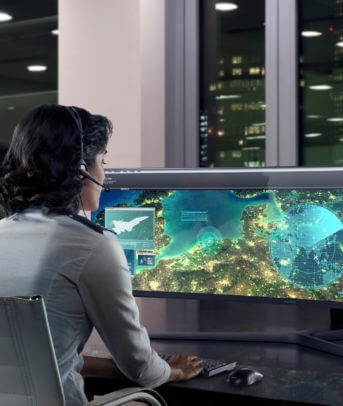
Within command hubs, large-format displays and video walls aggregate feeds and enable commanders to visualize operations at scale and push relevant information back to field operators for swift decisive action.
Together, these capabilities connect edge operators and command into a single, continuous decision environment. The result is a command model where decisions accelerate, and operators at every level are empowered to execute missions faster and safer.
Connecting information across domains
Command centers must integrate data to improve situational awareness and reduce the burden on field operators managing cross-domain inputs. For the modern command center, this means turning fragmented data into a unified operational picture.
Decision-advantage requires a shared, real-time understanding of the operational environment, and mobile ecosystems support persistent, connected communications across domains.
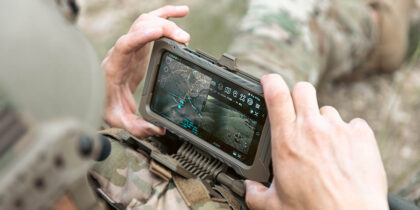
Applications like the Android Team Awareness Kit (ATAK) integrate data from ISR platforms, UAVs and sensors into a single, actionable view. Mobile platforms interface directly with mission systems, extending this shared view across users and operations. This allows commanders and operators to act from the same baseline no matter their location, improving coordination and reducing mission delays. For instance, live UAV imagery, sensor alerts and friendly force positions can be fused into a single view on a single device to enable shared understanding, faster target identification and coordinated response.
This shared context helps commanders and operators prioritize mission-relevant insights rather than overwhelming them with raw data. Additionally, seamless integration across LTE, LMR, private 5G and satellite networks helps maintain C2 continuity in dynamic environments. And mobile AI helps process large volumes of data, filtering noise and prioritizing mission-relevant insights to reduce cognitive load and support confident decision-making.
By simplifying the user experience, mobile platforms reduce system switching to improve speed, accuracy and alignment across operations. This shifts C2 from fixed to flexible and adaptive, supporting joint, all-domain and distributed operations.
The end result is a command center capability that is not just connected, but aligned to support contextual, informed decisions faster, in any location without fixed infrastructure.
Securing operations without interruption
In contested environments, every user, device and connection must be continuously protected to ensure operations can proceed safely and without interruption. Operators need to access sensitive information securely without limiting operational flexibility. This is critical in scenarios where devices may be lost or operating amid hostile networks on classified missions.
Samsung Knox provides hardware-backed security, encryption and real-time threat protection to ensure every user, device and connection remains trusted in contested environments. These security protections help prevent unauthorized access to mission data, even if a device is lost or compromised.³
Mobile device management capabilities enable centralized control, compliance and rapid deployment of mission applications. Features like over-the-air provisioning, policy enforcement and remote management allow operators to scale securely across devices. This helps commanders extend command center capabilities to the edge without introducing operational risk. For example, devices can be remotely updated, locked or wiped to maintain security without disrupting the mission. Or in other scenarios, devices can be configured and maintained in an entirely off-line manner for even greater security classification requirements.
By embedding resilience and security on-device, commanders can scale operations while ensuring decision advantage is not compromised.
The way forward
Modernization efforts across the Department of War (DOW) continue to focus on building a capable and fully interoperable force. Federal strategies call for integration across domains, emphasizing the need to operationalize data in real time to support unified operations, advanced visualization, decision dominance and improved C2.
Mobile ecosystems are poised to support this goal, helping unify edge computing, interoperability and automation to support modern command infrastructure and interoperable, decision-forward environments.
In this future state, devices are quickly becoming the mobilizing layer for decision advantage, making information actionable and usable at the speed and scale of modern warfare.
For more information on how mobile is powering modern C2 initiatives, click here.
1 These devices passed military specification (MIL-STD-810H) testing against a subset of 21 specific environmental conditions, including temperature, dust, shock / vibration and low pressure / high altitude. Real-world usage varies from the specific environmental conditions used in MIL-STD-810H testing. Samsung does not guarantee device performance in all extreme conditions. Consistent with IP68 rating, water resistant in up to 5 feet of water for up to 30 minutes. Rinse residue / dry after wet.
2 Samsung DeX supported on selected Galaxy, Note, and Tab devices. (More details on the FAQ Page)
3 For a full list of Knox certifications, visit: https://www.samsungknox.com/en/knox-platform/knox-certifications