Retailers are moving quickly from testing AI to discovering how it can improve their bottom line. In NVIDIA’s 2026 State of AI in Retail and CPG survey, 89% of respondents said AI is helping increase revenue. Many respondents also said AI led to improved employee productivity, operational efficiencies and customer service — three key elements to retail success.
For retailers already seeing gains from AI, the next opportunity is to bring those capabilities closer to the moments when sales are made or lost. Mobile solutions do just that by giving store associates and managers more ways to leverage AI insights in daily work. Here’s how.
Employee productivity
AI improves productivity by giving employees faster access to useful information, whether it’s product details, inventory tracking or sales data. For store associates, that can mean fewer pauses from customer engagement to ask another employee for routine answers, and more comprehensive and confident communication of information.
A mobile device like Samsung Galaxy S26 Series gives associates access to a suite of AI tools wherever they are. An employee could use Circle to Search with Google to find product details from an image, providing them with relevant information without stepping away from the floor. With the Interpreter feature, it can even provide live language translation, keeping the sales process going.
Productivity improvements like these reduce the small delays that add up over a shift, giving employees more time to work with customers.
Employee training and enablement
Retailers need new associates to learn product information and store processes quickly, especially during seasonal peaks and other busy periods. The faster employees become comfortable in their roles, the sooner they can support customers with confidence.
AI can accelerate onboarding by making training materials accessible at any time, and mobile solutions put that guidance within reach during the workday. Retail outlets may also create checklists for various tasks to assist with training, helping ensure employees follow and learn the correct procedures.
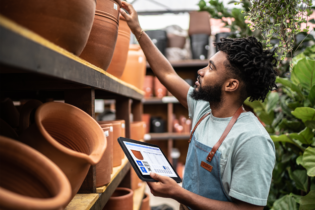
That gets even easier on larger screens, such as on Samsung Galaxy Tab A11+ and Samsung Galaxy Tab S11 tablets, which provide employees with an 11-inch screen to review content and receive guidance as they learn a new workflow. That’s ideal for viewing images, diagrams and video, too, as they are easier to see with the large size and high brightness.
Customer service
AI improves customer service by helping associates make store interactions feel more personal and useful. That kind of in-person guidance is one of the clearest ways stores can stand apart from purely digital shopping.
On Galaxy Tab S11, the display gives associates a larger, clearer screen for comparing options side by side and guiding a more consultative conversation. That combination of mobile technology and AI-supported customer service helps associates turn everyday store interactions into stronger sales opportunities.
With Chat Assist, they can more effectively reply to queries by email and text, or message customers via store apps. The feature adjusts text to a professional tone and cleans up grammar and spelling.
Operational efficiency
AI reduces friction across daily retail operations by showing teams what needs attention earlier. For example, AI-supported tools could alert a manager when a department is falling behind on tasks or needs additional associate coverage, helping them decide what to address first for more efficient retail operations.
Mobile solutions make those insights easier to access and act on. With Galaxy Tab S11, a manager could review store updates from the floor and use Google Gemini Live to talk through what is on screen as they sort through the issue. The included S Pen lets managers capture walkthrough notes directly on the tablet, while Note Assist helps organize those notes into clearer follow-up items.
That flexibility matters because operational issues rarely occur in a single fixed location. When teams can see what needs attention and respond from anywhere in the store, retailers can reduce delays that put sales at risk.
Inventory and fulfillment
AI can improve inventory and fulfillment by identifying potential stock issues before they affect customers. Mobile devices bring those insights into the work happening across the store. With Galaxy S26 Series, an associate could use AI-supported search to identify a product from an image, confirm its availability and locate the item.
Galaxy Tab A11+ provides fulfillment teams with a dedicated platform for managing pickup orders and keeping item statuses up to date as items are picked. It helps combine dispatch systems, navigational tools, barcode scanning and proof-of-delivery into a single workflow.
For employees constantly moving through the store and stockroom, wearables such as Galaxy Watch8 or Galaxy Buds4 could keep AI assistance within reach without requiring them to stop and pick up another device.
Together, these mobile solutions give teams a faster way to act on AI-driven inventory insight before a hard-to-find item or delayed pickup order turns into a lost sale.
Bringing AI closer to the moment of sale
AI’s value in retail depends on where it shows up. When AI insights reach the associates and managers closest to the customer, retailers have more opportunities to improve service and increase sales. Mobile solutions help make that connection, turning AI from a back-end investment into a practical tool for store-level results.
Learn more about how Samsung Galaxy S26 Series, Galaxy Tab S11 and Tab A11+ tablets can help generate retail revenue. Also, discover the most innovative business tablet use cases.