Hotels have discovered a powerful ally in delivering hospitality — wearables. As technology continues to advance, especially with the integration of AI, hotel operators, managers and staff are being equipped with a suite of digital tools to level up operations across every part of the guest experience. And wearables do it with convenience and ergonomics, fitting in the ears, wrapping around the wrist and slipping on a finger, keeping hands free to complete daily tasks.
In the bigger picture, wearable technology may also help hotels address labor issues the industry continues to struggle with. As a 2026 survey by the American Hotel and Lodging Association (AHLA) revealed, more than half of respondents say their properties are “somewhat or severely understaffed.” The issue is compounded by the costs of closing the gap, including higher wages and more benefits, underscoring AHLA data showing hotel operating costs rising four times faster than revenue this year.
Here’s how equipping hotel staff with smart watches, earbuds and rings can help make the difference.
How employee wearables improve hotel operations
The latest wearable technology elevates hotel operations in several ways. With devices like Samsung Galaxy Watch8, Samsung Galaxy Ring and Galaxy Buds4, management and staff can improve:
Response times
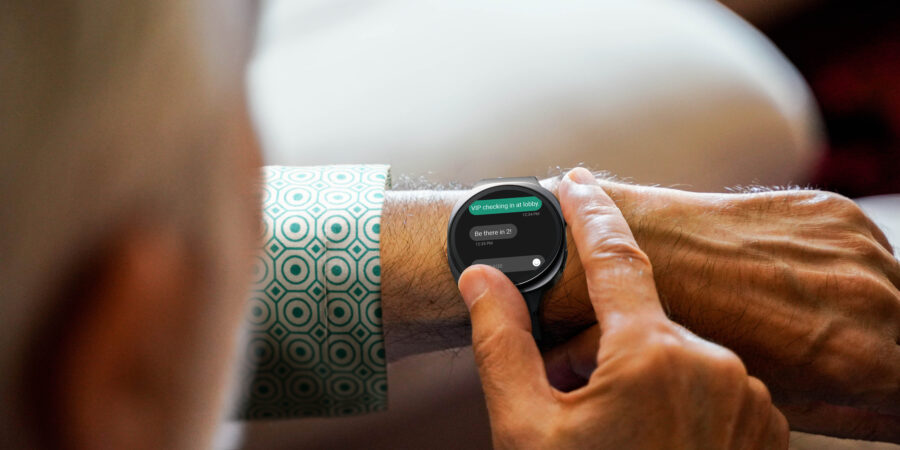
Communications reach team members almost instantly, because they don’t have to wait for a sound or vibration — which they could miss — and put everything down to fish a mobile device from a pocket, activate the screen, read a message and respond. A smart watch and earbuds deliver the message hands-free and instantly, which staff can acknowledge with a brief touch of the wearable device or a gesture.
Language translation
Because Samsung wearables are linked to Galaxy AI, they can access the Live Translate and Interpreter features, which cover 22 languages. The translations are either fed to your Watch8 or Buds4 from a linked Samsung mobile device, such as Galaxy S26 Series, or through downloadable apps on the watch, including Google Translate. Voice-to-text dictation also allows staff to convert speech into the desired language.
Communication efficiency
With radios, staff members often have to share channels and wait for clear moments to communicate. Digital messaging opens more communication routes, but inboxes often fill quickly, forcing workers to constantly sift through them to find the relevant messages. Wearables address this by providing streamlined profiles to designate specific communication groups for each type of alert and message.
Service quality
If a staff member does not touch their smart watch to acknowledge an assignment within a set time, the software’s logic engine automatically escalates it to other staff members or a supervisor to ensure guests are served quickly. The instant communication also enables rapid task pivoting as priorities and conditions change, ensuring that available resources are directed to where they are most needed at any given moment.
Tracking and scheduling
Staff members touch the smart watch or make a gesture to acknowledge receipt of a task, and again when they complete it. In the short term, this helps managers keep precise tracking. In the long term, it gives managers insight into response and task times, enabling them to schedule more effectively and match the right number of team members to workflows.
Employee satisfaction
Staff members appreciate being equipped with cutting-edge technology that streamlines tedious tasks and enables them to focus on the best parts of their jobs. Samsung wearables also let them keep an eye on their health by measuring heart rate, pulse, stress, energy levels and other key indicators.
How hotel staff can use wearables at work
Wearables help break down departmental silos by enabling easy, quiet, hands-free communication and collaboration across any hotel-defined group. That’s ideal for requests and tasks that cross department boundaries.
Key hotel operations use cases for employee wearables include:
Bellhop and valet: Staff members can receive updates on guest arrivals and special requests, even while carrying bags or retrieving a car. Wearables enable a quick, hands-free glance at the next task, and optional LTE capability reaches garages and other areas without Wi-Fi coverage.
Housekeeping: The task management system automatically locates the closest staff member for a towel or bottled water request and sends a silent, vibrating alert to the watch, so guests aren’t disturbed by a ringtone or squawky radio. Via push-to-talk, staff members can instantly communicate with the team to coordinate cleaning or request supplies.
Front desk: Guest-facing staff here can communicate more effectively with international guests, especially those who speak other languages. They may also notify other team members about requests and needs. Hotel managers can redirect staff to the front desk during high-traffic times around check-in and checkout.
Maintenance: Instead of tracking down the best available repair technician by radio and then calling the guest with an expected wait time, the system can quickly locate the tech, send an instantaneous response and get back to the guest much faster. Applications may be used for staff to record maintenance status via daily checklists, which Galaxy AI can analyze to improve predictive maintenance.
Security: Hotel security staff can communicate instantly and discreetly, avoiding noisy disruptions that unnecessarily disturb and alarm guests. Emergency situations can also trigger alerts on wearables, enabling faster response times.
Training and upskilling through XR
One of the latest breakthroughs in wearable technology arrived with extended reality (XR). Headsets like Samsung Galaxy XR provide powerful tools for training and upskilling. When immersed in XR, hotel staff may run through a variety of scenarios and practice responses, so they’re more ready for what happens in the real world.
Technicians benefit from Galaxy XR, too, as it can provide real-time support and instruction for maintenance issues, such as setting up AV equipment in a conference room, configuring a smart thermostat or repairing a piece of machinery.
Making wearables work
Keeping hotel operations humming and guests satisfied demands carefully orchestrated communication and coordination. Samsung wearables help make that happen, thereby boosting guest satisfaction and brand loyalty. That ensures a stronger, more stable revenue stream that can grow as more stars and praise are added to guest reviews, raising ratings.
Discover how connected workers speed AI integration in hotel technology. Also learn how you can impress your guests and streamline operations by checking out Samsung hospitality technology solutions.