Every year, millions of patients leave the hospital in better shape than when they arrived. But care does not always end with discharge. In fact, the weeks and months that follow contribute much to recovery and treatment. Filling prescriptions, taking medications correctly, keeping follow-up appointments and catching early warning signs before they escalate all fall to the patient once they get home, and almost none of it is immediately visible to clinicians.
Unfortunately, many patients struggle during this fragile period and must return to the hospital. According to Definitive Healthcare, the average U.S. hospital readmission rate reaches roughly 15%, meaning about one in seven patients ends up back in the hospital within 30 days.
The good news is that digital tools are expanding care options for patients at home, giving providers a better chance to reduce readmissions and improve outpatient care when used properly. Here’s how.
Discharge as a transition, not an endpoint
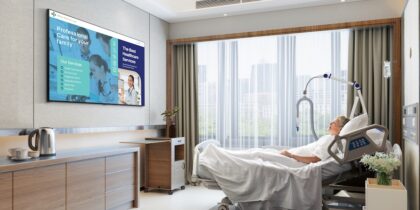
Patient discharge can feel like a finish line, but it’s often the start of the hardest part of recovery. A hospital is a highly structured, monitored environment where nurses and clinicians administer medications on schedule and monitor vital signs around the clock. But home lacks that scaffolding, and recovery often falls to patients who may still be weak, overwhelmed or unsure.
That’s important because readmissions aren’t necessarily caused by the original illness coming back in force, but rather by smaller breakdowns that accumulate over time, like a prescription that goes unfilled or a symptom that progresses into an emergency. Home care tends to work better when it’s seen as one step of a larger process, not a separate or isolated experience.
The at-home balancing act
Medications are often where the strain first shows. A patient may leave the hospital with several new prescriptions, each with its own schedule and instructions that even healthy people would struggle to manage. Indeed, medication non-adherence is a serious issue in those first days out of the hospital, with a 2026 report by Synchronyx revealing a rate of 72% within the first 30 days of therapy.
Follow-up care adds more challenge. Appointments must be scheduled and transportation arranged, often alongside a list of questions saved for a provider who may not be available for weeks. For a patient who still is not feeling like themselves, any one of these tasks is easy to miss. When several go unaddressed at once, the risk builds.
Small nudges, measurable signals
Some of the most encouraging progress in post-discharge care has come from digital tools that ask very little of the patient. A well-timed text message reminding someone to fill a prescription sounds almost too simple to change an outcome, but the evidence suggests otherwise.
One 2025 study followed 1,276 heart failure patients and compared those who engaged with SMS medication reminders to those who did not. Patients who interacted with the nudges had 19% higher odds of filling their prescriptions and 6% lower odds of being readmitted within 30 days. Among patients who had already been hospitalized once, the effect on fill rates was stronger still. Quick, timely touch points can nudge patients toward action when it could mean the difference between a setback and recovery.
Extending visibility with remote monitoring
Text reminders address one piece of the puzzle. Remote patient monitoring addresses a larger piece, restoring some of the clinical visibility that disappears at discharge.
Connected devices that track weight, blood pressure, blood oxygen or heart rate can flag early signs of trouble before a patient recognizes them. For conditions like heart failure and chronic obstructive pulmonary disease, where a gradual change may precede a serious decline, the early window is potentially lifesaving. A systematic review and meta-analysis found that remote biometric sensing works largely by enabling early detection, giving clinicians time to intervene before a patient’s condition forces a return to the hospital.
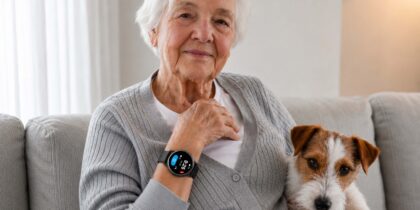
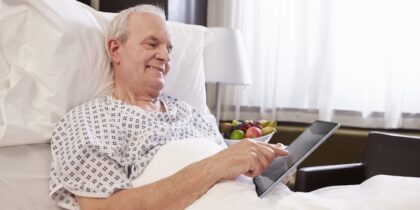
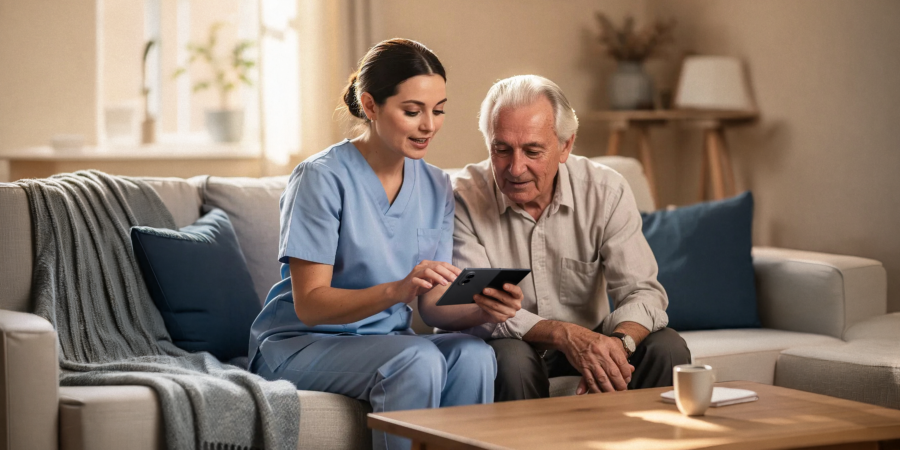
Mobile devices make home monitoring more attainable. The most useful setups run on devices patients already carry, including mobile devices, tablets, and wearables. When readings, reminders and video visits live on one trusted device, adherence gets much easier.
Closing the loop with care coordination
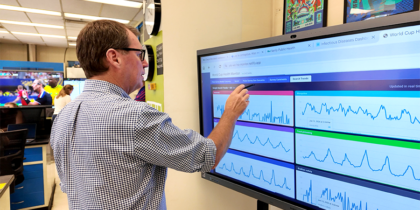
A blood pressure reading or a filled prescription is only as useful as the response it prompts. The payoff of digital engagement arrives when the information it generates flows back to care coordinators rather than sitting in a dashboard no one opens.
When adherence data, patient-reported symptoms and monitoring readings reach clinicians in a usable form, they can reshape how and when a care team reaches out. A missed refill can trigger a pharmacist’s call, and weight fluctuations can prompt a nurse to adjust a care plan. When someone reports worsening symptoms through an app, the care team can quickly route them to the right level of care, instead of leaving them to wait for a scheduled visit or end up in the emergency department.
The last mile is a human one
Digital engagement is changing what care can look like after a patient goes home. Text nudges, connected devices and coordinated data are helping clinicians stay present through a stretch when they once lost sight of the patient, and early evidence points to gains in adherence, visibility and timely intervention.
Nevertheless, the relationship with caregivers is essential to success. The tools work best when they extend that relationship into the home, not replace it. A text reminder helps because it connects to a real prescription a human clinician wrote. A monitoring alert becomes effective when an actual nurse is ready to respond.
Health systems that master the last mile will use technology to stay close to patients during the vulnerable weeks when it matters most.
See how the right mobile technology can extend care beyond the hospital with Samsung healthcare technology solutions.