Whether navigating crowded airports, browsing store shelves, checking out the latest deals at the mall or exploring new destinations, today’s consumers expect instant, reliable access to the information that matters most. They want clear, up-to-date details on product pricing and features, and seek straightforward directions through busy terminals in stations and ports. Meeting these expectations requires more than a traditional static poster; it calls for a smarter, more dynamic solution.
This means incorporating E-Paper displays to provide consumers the details they need with flexibility and efficiency. Given that E-Paper is a new area of innovation for many, here’s a simple rundown on the differences between a poster vs. E-Paper, and why the latter represents a new platform for digital communication in the retail and transportation industries.
Enhanced customer engagement
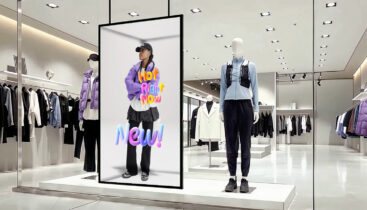
One key difference when comparing a poster and E-Paper is that the former is limited to static, one-way communication between businesses and consumers. The latest 13” EMDX Series Color E-Paper Smart Signage and the 32″ Color E-Paper EMDX Series Color QHD Smart Signage by Samsung, on the other hand, enable retailers and transportation firms to get more creative and drive more dynamic interactions with passengers and customers in real time.
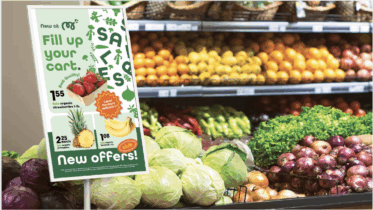
For example, a Samsung E-Paper can showcase featured products one week and then seamlessly shift to flash sales and promotions the next. In airports and terminal stations, E-Paper displays can act as digital information boards, where updates may be rolled out easily, even remotely.
Both models of EMDX provide businesses with omni-channel messaging options, too. Customers can scan a QR code and be taken to landing pages or websites. E-Paper may also take it one step further by connecting to mobile apps and digital check-in interfaces.
Seamless wayfinding
Retailers often need to change product assortment and sometimes even move entire departments from one area to another. And gate changes happen at airports every hour, with departures and arrivals often shifting, too. This is why businesses need to create an environment that customers and passengers can easily navigate.
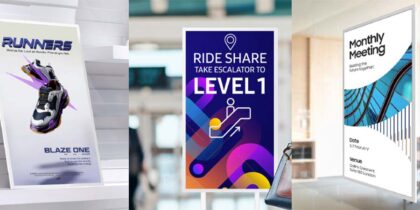
Samsung E-Paper addresses this directly by providing a highly visible means of placing landmarks, airport gates and store departments on a simple map. When the route from A to B changes at the last minute, it can be communicated more quickly and precisely than with traditional posters. With this wayfinding support, customers and passengers are better able to get where they need to go.
High visibility
One major advantage of an E-Paper display over a poster is the clear visibility. While a poster’s visibility may depend on the color, thickness and freshness of ink, as well as the clarity of the handwriting — both of which fade over time — E-Paper presents content with maximum vibrancy. That’s because of high resolution and an advanced color imaging algorithm that optimizes content for paper-like visibility.
Because it’s digital, E-Paper ensures clarity and consistency of images and text. They also boost the quality of both significantly, particularly when combined with the content production abilities of Samsung VXT, a cloud-based content management system. Just consider the difference between a high-resolution image of a product or map versus a hand-drawn rendering dependent on the artistic skill and available time of the person wielding the pen.
Samsung E-Paper leverages the portability of paper posters, too. Ultra-light and ultra-thin, both models are easy to place in high-traffic areas and then move to others as patterns shift throughout the day. The lightweight frame, especially of the 13″ EMDX, also makes E-Paper incredibly easy to hang without special supports and place atop tabletops. This ensures the information can meet the people where they are.
Cost savings
It may look like a simple piece of printed material on a wall, but the process of putting up posters might involve considerable expense. This includes not only printing but shipping and receiving costs, too, as well as the considerable time spent by paid employees.
When posters require new content or information, for instance, staff members need to physically visit every spot. This is followed by time spent unpacking posters, physically installing them and disposing those that are no longer relevant. These labor costs add up over time and take away from the opportunity to allocate the same team resources elsewhere.
Samsung E-Paper solutions provide an affordable alternative because they can be freely moved in wireless mode or connected with a single PoE dongle, allowing someone to unpack, connect and install them in a matter of minutes.
Once they’re in operation, devices are controlled both locally and remotely via Samsung VXT or the Samsung E- Paper App. This way, content is updated without having to check the budget for labor costs.
A clear advantage
There’s no need to debate using a poster vs. E-Paper any longer. Solutions like the Samsung Color E-Paper are giving businesses the hassle-free way to digitize the traditional paper experience they have been waiting for.
See how Samsung E-Paper is the one display that fits everywhere. And learn more about how Samsung Color E-Paper EMDX Series can provide your business with a new form of digital communication for your customers.