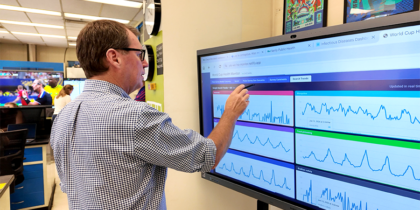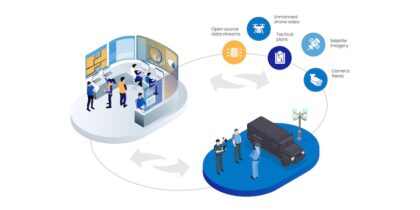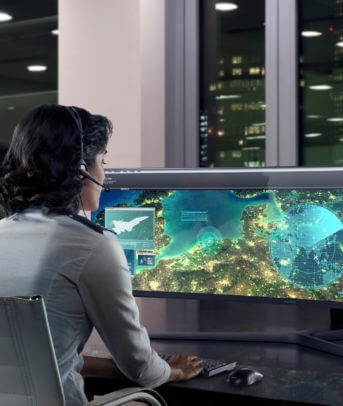
Building and running a modern control room is getting simpler for state and local governments, thanks to advances in LED video technology. As LED video screens evolve, control room staff can rely on sharp, crisp video in emergencies where fuzzy imagery could have life-or-death consequences.
All-In-One LED screens are a big part of that shift. They require no peripherals because the speakers are built in, and the control box is integrated into the screen structure, so there’s one less device cluttering a space. That’s creating new opportunities for dispatch centers, transit agency control rooms and other sites that require real-time video feeds and data streams. Here’s how.
The value of All-In-One LED video screens
When a suburban city in the U.S. Sun Belt needs a new 911 dispatch center for its growing population, or a state in the Mountain West needs to replace an aging wall-sized monitor in its transportation control room, LED video technology offers an ideal solution. LED video feeds feature rich colors and strong contrasts that are essential for viewing from 10 or more feet away. What’s more, large-size models like Samsung The Wall MMF-A (All-In-One) Large LED Display can host numerous streams at the same time, keeping critical data and information in one place for easier access and action.
Unfortunately, big-screen installation and management traditionally tended to be clunky and complicated. An unsightly controller box could dangle below a big screen, or it might take all day to install and configure a new screen. All-In-One LED displays like The Wall MMF-A have solved this problem.
A simpler standard for control room displays
The Wall MMF-A (All-In-One) Large LED Display illustrates why this category is ideal for state and local government:
- Fast installation. Samsung’s Quick Build Structure uses an easy mounting system made up of two background plates and four preset modules. The result is a top-of-the-line, 136-inch monitor that can be up and running in two hours.
- Automated configuration. There’s no need to mount a control box in a cabinet or on a wall because the controller is integrated into the screen design.
- No peripherals. Built-in speakers provide all the sound a control room might need, and decorative bezels and wall brackets ship in the box.
- AI-optimized picture quality. MMF-A’s NQM AI processor analyzes every frame in real time, sharpening contrast and reducing noise, while HDR10/HDR10+ support enhances brightness and contrast for more accurate color and depth.
- Multi-screen flexibility. Up to four displays can be connected side-by-side and controlled with a single remote, making it easier to scale a control room’s video wall as needs grow.
The speed and simplicity help in-house agency technical staff quickly attend to other responsibilities once the screen is installed.
Where AI fits into the modern control room
AI is no longer a background feature of control room displays; it’s central to how agencies get more out of the video feeds they already have. On an All-In-One LED display like MMF-A, that processing happens automatically and continuously, frame by frame, without an operator needing to manually tune settings.
For state and local government, this makes a real difference. Clearer, more consistently optimized video means dispatchers and control room operators spend less time squinting at degraded footage and more time acting on it. It’s a meaningful difference when a delayed read on a live feed can slow an emergency response. And because the AI processing happens automatically on the display itself, it lessens the burden on an already-stretched technical team to configure or maintain.
Security and privacy details that can’t be overlooked
On any system for state and local governments, data security is essential. Samsung bakes that into its cloud-based content management system, Samsung VXT. In fact, VXT carries ISO/IEC 27001 certification, the international standard for privacy information management, and ISO/IEC 27701 certification, which specifies requirements for establishing, implementing and maintaining a Privacy Information Management System.
VXT gives technical staff granular control over their display fleet in control rooms. Administrators can lock down USB ports, Wi-Fi and Bluetooth connections to prevent unauthorized access or tampering, as well as restrict who’s able to push content to a screen.
A hybrid approach for government environments
For agencies where a fully cloud-based approach isn’t appropriate, VXT also supports a hybrid solution with an on-premises hosted server. This gives government organizations the option to keep sensitive data within their own infrastructure while still benefiting from centralized display management and remote content deployment.
That flexibility can be particularly important for state and local government agencies with stricter data residency, security or compliance requirements. Rather than forcing every organization into the same deployment model, a hybrid approach allows agencies to align display management with their existing IT and data policies.
Simplicity that scales
From installation, daily operation to security and deployment, the same principle holds: an All-In-One display built for control rooms gives staff one less thing to work around — and one more thing to work with. For state and local governments, that simplicity can extend beyond the display itself. With flexible deployment options, including a hybrid solution for agencies that need to keep sensitive data on premises, modern control room technology can fit more easily within existing IT environments and security requirements.
The result is a control room that’s easier to install, simpler to manage and designed to support the people who rely on critical information every day.
Learn more about The Wall MMF-A (All-In-One) Large LED Display and explore other innovative Samsung displays.