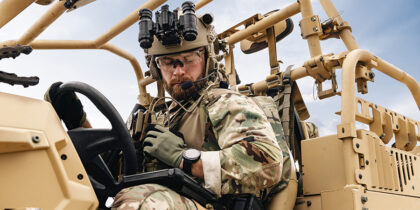
Decision advantage is won or lost at the tactical edge. Defense modernization is driving unprecedented volumes of data to the battlefield, expanding what’s possible while making informed decision-making more complex.
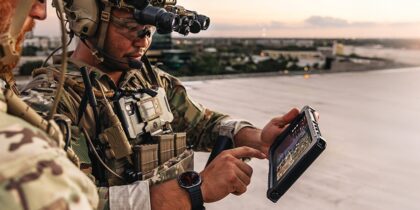
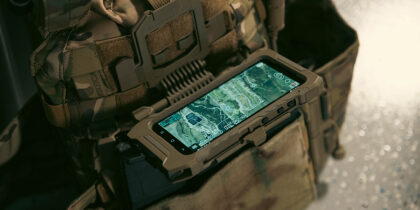
This is where modern end-user devices (EUDs) come in. No longer just communications hardware, EUDS have evolved into decision platforms that form the backbone of frontline intelligence, helping operators make sense of information at the speed and scale of modern defense.
Built on customized commercial off-the-shelf (COTS) mobile device technology, modern EUDs translate the speed of innovation into mission-ready capability, pushing critical information to the frontline even in the most degraded, disconnected environments.
Below are five EUD imperatives shaping decision advantage across an increasingly dynamic landscape.
1. Always-on connectivity
From sensor feeds to video and more, next-generation command and control (C2) must deliver always-on connectivity.
Persistent, real-time connectivity remains one of the hardest challenges at the tactical edge. Conditions are constantly changing, and connections are often disrupted or denied. EUDs that can connect to multiple simultaneous disparate networks bridge the gap by ensuring critical information remains accessible and actionable, even when connectivity is inconsistent.
In the modern battlespace, warfighters need high-performance devices that provide simultaneous, multi-path connectivity across cellular, tactical radios and Wi-Fi, preserving application sessions and essential operations data when it matters most.
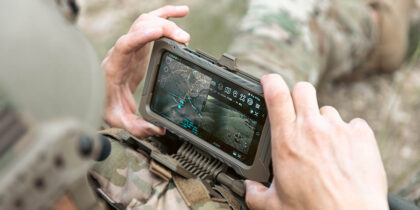
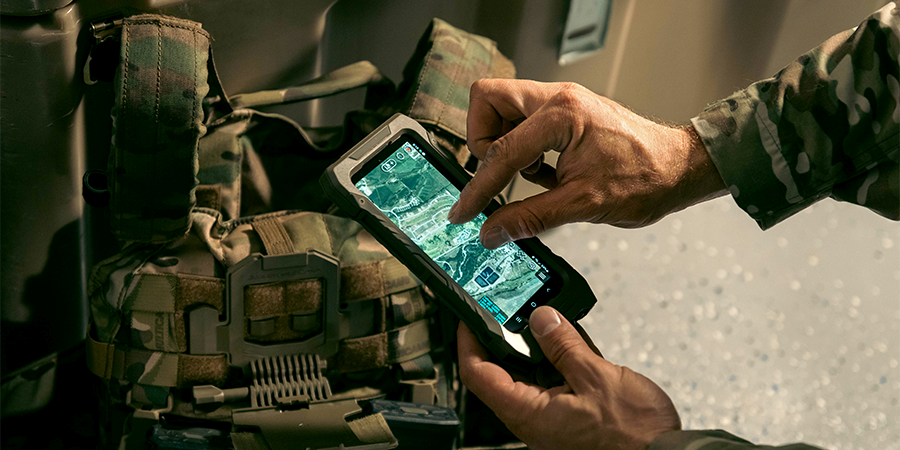
When paired with Android Team Awareness Kit (ATAK) and similar applications, EUDs provide reliable visibility across the mission, including insight into drone video, force movement, emerging threats and more.
This makes EUDs reliable force multipliers, helping reduce uncertainty and enable situational awareness across tactical communications environments.
2. Military-grade resilience
Devices are the critical interface between data input and human action. Modern EUDs have military-grade processing power and are ruggedized for reliability across extreme conditions.
Service members need to focus on the operation at hand, confident that their devices and connectivity will perform under the most demanding conditions.
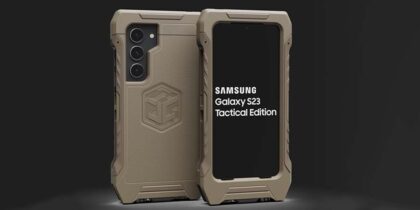
Military-grade EUDs deliver resilience without compromising performance. Ruggedization ensures devices remain trusted, usable and mission-ready under the physical and environmental stressors of frontline operations. For example, EUDs must withstand the physical stresses often encountered by dismounted soldiers and meet MIL-STD-810H and IP68 standards. Effective devices operate reliably under shock, vibration, extreme temperatures and exposure to dust and water. In addition, rugged designs are often complemented by mission-focused features like enhanced touchscreen sensitivity for glove and wet-touch use and replaceable batteries, supporting adaptability as mission conditions evolve.
Without rugged devices, decision advantage can collapse the moment conditions degrade. Durable, reliable mobile devices ensure missions continue seamlessly.
3. Secure, distributed operations
More autonomous teams, smaller units and greater geographic separation require centralized control so operators can remain synchronized without traditional reachback.
To stay aligned, operators need integrated networking and on-the-move capability without being tied to fixed infrastructure. When seamlessly integrated with leading C2 applications, EUDs enable shared situational awareness while maintaining strong security and rapid threat detection from concept through deployment. By integrating multiple data feeds to one device, EUDs support distributed and multi-domain operations and extend decision advantage to the edge.
Paired with ATAK, they deliver a comprehensive common operating picture with visibility into blue force tracking, adversary movements, drone feeds and other mission-relevant data. In addition, large-format LED displays enhance edge visibility by integrating disparate camera and data feeds for operational advantage.
Secure, distributed operations are enabled by EUDs that safeguard data and decision-making wherever teams are deployed.
4. Open architecture
Gone are rigid systems; the ultimate EUD test is flexibility and adaptability. Open architecture provides rapid integration and visibility across mission tools.
If systems can’t integrate, they can’t adapt. Operators on the frontlines need to be integrated with support from open APIs and broad partner ecosystems designed for interoperability.
Customized COTS, delivered through open architecture, turns EUDs into flexible, interoperable platforms that can adapt and evolve with mission needs. Flexible and secure solutions support seamless shared data across units, platforms and partners, helping accelerate decision-making by enabling coordination at scale.
EUDs operate as integrated elements within multi-domain environments rather than as isolated endpoints. Built on open platforms, they can support integration with tactical radios, external GPS devices and other mission systems and applications. This open architecture enables service members to access and present mission-relevant information directly on their devices. Perhaps most importantly, a flexible, extensible ecosystem allows devices to adapt as mission requirements or operational conditions change.
Open architecture supports integration at the speed of operations. This flexibility ensures systems can adapt as missions and threats change, future-proofing operations by supporting application, data and system integration.
5. Leveraging edge AI
Human-machine teaming is a game changer at the edge. When humans are supported with the right information and context at the right time, they can make rapid, informed decisions.
As military missions become more complex, AI-enabled capabilities are bringing intelligence closer to the edge. Streamlined, on-device AI delivers controlled, resilient intelligence, reduces latency and keeps data secure and mission-ready. By tightly controlling how AI is deployed and applied, teams can accelerate comprehension, filter relevant data and prioritize what matters most in high-pressure environments.
AI features can support functions without continuous cloud connectivity, including local language translation and intelligence assistance. In addition, wearable ecosystems further extend awareness through on-device sensors and AI-enhanced insights on health and performance trends. Another growing area of AI support is training, where AI-powered headsets complement real-world skills development with virtual and augmented reality to improve force readiness.
Ultimately, AI-enhanced capabilities are helping reduce cognitive burden to deliver a critical advantage through faster, more informed decision-making across operations and training environments.
The edge-enabled future
Advanced mobile solutions are strengthening command and control while delivering real-time situational awareness to support decision dominance. By powering decision-making and agility, these technologies are reshaping force readiness and advancing the intelligent edge.
Samsung Tactical Edition devices, wearables and more are tested and proven across these five imperatives, helping our military leverage commercial technology while maintaining the resilience, security and reliability missions demand.1,2
Put simply, the right EUDs fade into the background so our men and women in uniform can stay ahead of ever-evolving threats, defeat our adversaries, enable modern C2 and achieve ultimate decision advantage.
For more information on how Samsung EUD’s are supporting military readiness and decision superiority, click here.
1Cases, cables and accessories are sold separately.
2For a full list of Knox certifications, visit: https://www.samsungknox.com/en/knox-platform/knox-certifications